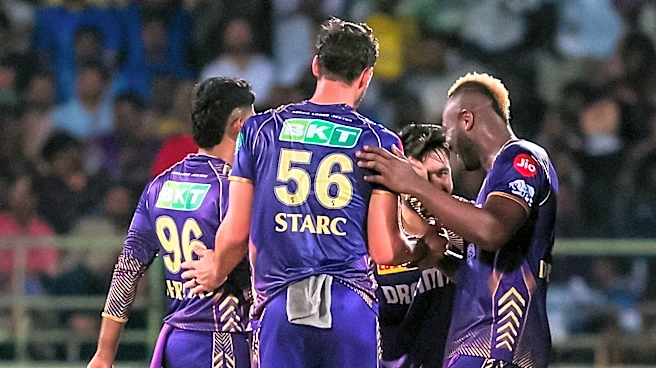




What's Happening?
The Kolkata Knight Riders (KKR), a three-time Indian Premier League (IPL) champion, is confronting significant player retention decisions as the November 17, 2026, deadline approaches for the IPL 2027 mini-auction. The team, which won its third title
in 2024 under Shreyas Iyer's captaincy, has experienced a decline in performance, finishing eighth and seventh in the last two seasons and missing the playoffs. This downturn followed the release of Iyer before the 2025 season and the subsequent retirement of Ajinkya Rahane, who had captained the team. Rahane's retirement leaves KKR without a confirmed captain for the upcoming season. Among the players under consideration for release is New Zealand all-rounder Rachin Ravindra, who was acquired for INR 2 crore at the IPL 2026 auction but did not play in any matches during that season. KKR already has other overseas top-order options in Finn Allen and Tim Seifert, making Ravindra's inclusion in the playing XI challenging. The franchise is evaluating its roster to optimize its squad ahead of the auction scheduled for December 16, 2026, in Goa.
Why It's Important?
The strategic decisions made by KKR regarding player retention will significantly impact the team's competitiveness and financial flexibility for the IPL 2027 season. Releasing players like Rachin Ravindra, who cost INR 2 crore, would free up substantial funds that KKR could then utilize to acquire new talent at the mini-auction. This financial maneuver is crucial for rebuilding a squad that has underperformed in recent seasons. The absence of a confirmed captain following Ajinkya Rahane's retirement adds another layer of complexity, as the team will need to identify a new leader who can steer them back to championship contention. The choices made now will not only shape KKR's immediate future but also influence the broader IPL landscape, as other franchises will be keenly observing which players become available and how KKR reconfigures its team. The success or failure of these retention strategies could determine KKR's trajectory for several seasons to come, impacting fan engagement and commercial interests.
What's Next?
With the retention deadline set for November 17, 2026, KKR is expected to finalize its list of retained and released players. Following this, the franchise will prepare for the IPL 2027 mini-auction on December 16, 2026, in Goa. During the auction, KKR will aim to acquire new players, including a potential captain, to strengthen its squad. The funds freed up by releasing players like Rachin Ravindra will be critical in securing high-value talent. The team will also need to address its batting inconsistencies and overall team composition to improve its performance in the upcoming season. Potential reactions from stakeholders include fan scrutiny over player releases and acquisitions, as well as strategic moves from rival franchises looking to capitalize on available talent. The decisions made in the coming weeks will lay the groundwork for KKR's strategy to reclaim its position as a top contender in the IPL.
Beyond the Headlines
The challenges faced by KKR, particularly the struggle to maintain performance after a championship win and the subsequent leadership vacuum, highlight the dynamic and often unpredictable nature of professional sports leagues like the IPL. The constant need for roster adjustments, financial management, and leadership transitions underscores the complex interplay of athletic talent, strategic planning, and economic considerations. The decision to release a player like Rachin Ravindra, despite his potential, reflects the harsh realities of squad optimization where overseas slots are at a premium and immediate impact is often prioritized. This situation also brings to light the broader implications for player careers, as even talented individuals may find themselves on the sidelines due to team dynamics and strategic choices. The ongoing evolution of team rosters and leadership within the IPL demonstrates the continuous cycle of rebuilding and adaptation required to stay competitive in a high-stakes environment.