








What's Happening?
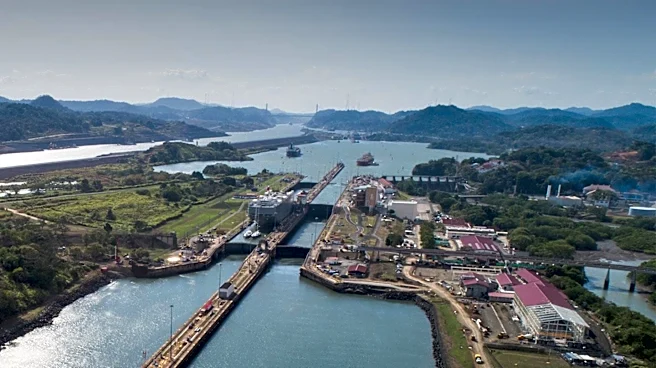
Hong Kong conglomerate CK Hutchison Holdings (CKH) is seeking $1.5 billion in damages from the Panamanian government. This action follows Panama's seizure of ports that CKH's unit was operating at both ends of the strategic Panama Canal. The concession
loss for CK Hutchison occurred in a geopolitically charged case. The Panama Canal is a critical global shipping route, and the control of its ports has significant international implications. This development highlights ongoing tensions and disputes surrounding key infrastructure assets and international business operations, particularly in regions with strategic importance. The claim for damages underscores the financial impact and legal complexities arising from such governmental actions against private enterprises.
Why It's Important?
This dispute is important due to the strategic significance of the Panama Canal, a vital artery for global trade, including U.S. shipping. The seizure of port operations from a major international conglomerate like CK Hutchison, and the subsequent demand for $1.5 billion in damages, could set a precedent for how governments interact with foreign investors in critical infrastructure. For U.S. industries, stability and predictable operations in the Panama Canal are crucial for supply chains and trade efficiency. Any disruption or legal uncertainty could lead to increased shipping costs or delays. The case also reflects broader geopolitical dynamics, as the control of such strategic assets can become a point of contention between nations and influence international relations and investment climates. The outcome could impact future foreign direct investment decisions in similar strategic locations globally.
What's Next?
The legal proceedings between CK Hutchison and the Panamanian government will likely continue, focusing on the $1.5 billion damages claim. This process could involve international arbitration or court battles, potentially spanning several years. The resolution of this case will be closely watched by international investors and governments, as it may influence future investment agreements and the perceived risk of operating critical infrastructure in various countries. Depending on the outcome, Panama might face significant financial liabilities or reputational damage, affecting its ability to attract future foreign investment. Conversely, a favorable outcome for Panama could embolden other nations to exert greater control over strategic assets. The situation could also draw attention from international bodies concerned with trade and investment law.
Beyond the Headlines
Beyond the immediate financial claim, this event highlights the increasing trend of governments asserting control over strategic national assets, often driven by geopolitical considerations or national security concerns. The Panama Canal, being a critical chokepoint for global maritime trade, makes its control a matter of national and international interest. This case could prompt a re-evaluation of investment protection treaties and the mechanisms for resolving disputes between states and foreign investors, particularly in sectors deemed vital. It also underscores the complex interplay between economic interests, national sovereignty, and international law, potentially leading to a more cautious approach by multinational corporations when investing in politically sensitive infrastructure projects. The long-term implications could include a shift in how international concessions are structured and enforced, with greater emphasis on political risk assessment.