







What's Happening?
The Macon Water Authority (MWA) has successfully closed a $70.1 million bond deal at a 2.31% rate, securing funds for its five-year capital improvement plan and for restructuring existing debt. Both Moody’s and S&P Global affirmed the authority’s long-term
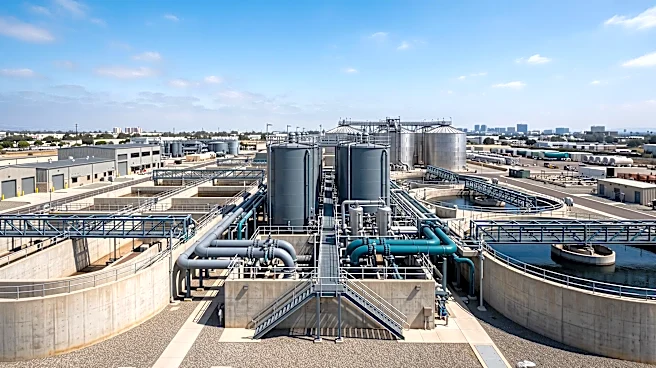
credit ratings at Aa2 and AA/A-1+, respectively, for these Series 2026A bonds. Stifel Managing Director Trey Monroe highlighted that the rating agencies thoroughly assessed MWA's capital projects and financial outlook, concluding that the additional debt would not adversely affect its rating. The $70.1 million represents the initial funding tranche for the MWA's $189 million capital improvement plan, which was approved in September. Approximately $50 million from these new bonds will be allocated to the expansion of the Rocky Creek Water Reclamation facility, with the remaining funds designated for restructuring prior debt. MWA's total outstanding debt now stands at $231.3 million. The authority's short-term bond rating also achieved the highest level of A1+, making its bonds eligible for purchase by money market funds and other short-term investors.
Why It's Important?
This successful bond issuance and maintenance of strong credit ratings are crucial for the Macon Water Authority's financial stability and its ability to invest in critical infrastructure. The $70.1 million in funding will directly support essential upgrades and expansions, such as the Rocky Creek Water Reclamation facility, which are vital for providing reliable water and sewer services to the community. The affirmation of high bond ratings by Moody's and S&P Global signals confidence in MWA's financial management, proactive rate-setting, and overall operational health. This favorable rating allows MWA to borrow at lower interest rates, saving taxpayer money and ensuring that capital projects can proceed efficiently. Furthermore, the eligibility of MWA's short-term bonds for money market funds broadens its investor base, enhancing liquidity and financial flexibility. The ongoing capital improvements, including meter upgrades, are expected to improve consumption accuracy and increase revenue from both large users and residential customers, further strengthening the authority's financial profile.
What's Next?
The Macon Water Authority will proceed with its $189 million, five-year capital improvement plan, utilizing the newly secured $70.1 million. Key projects include the expansion of the Rocky Creek Water Reclamation facility, which is currently in the engineering design and final cost estimate phase, and the design of an $18 million alternative power substation with Georgia Power. Improvements at the Lower Poplar Water Reclamation Facility, including pump station upgrades and electrical enhancements, are nearing completion, alongside ongoing sewer line rehabilitation. The authority will also continue with the $3.3 million Allen Road-Echeconnee sanitary sewer extension and structural repairs at the Amerson Water Treatment Plant. The $17 million project to replace large commercial meters with Advanced Metering Infrastructure technology will also continue, with an average of 50 appointments scheduled bi-weekly. MWA plans to meet in December for a presentation on customer service and will consider inviting state legislative delegation members to discuss potential sales tax relief proposals for water, sewer, and stormwater infrastructure improvements during the upcoming Georgia General Assembly session.
Beyond the Headlines
The Macon Water Authority's strategic financial management, evidenced by its ability to secure significant funding while maintaining high bond ratings, reflects a broader trend among essential public utilities to proactively address aging infrastructure and meet growing demand. The emphasis on capital improvement plans, funded through bond issuances and supported by consistent rate increases, highlights the long-term commitment required to ensure sustainable public services. The proactive approach to rate setting, as noted by Moody's, demonstrates a forward-thinking strategy to secure financial health rather than reacting to crises. This model of responsible fiscal planning and investment in infrastructure is critical for urban development and public health. The ongoing meter replacement project, aimed at improving consumption accuracy, also points to the increasing adoption of technology to enhance operational efficiency and revenue generation in public utilities, ultimately benefiting both the service provider and its customers through more accurate billing and resource management.