





What's Happening?
Boom Supersonic has successfully conducted the first ground test of its prototype engine core, a critical component for both its Symphony turbofan engine designed for the Overture supersonic airliner and a gas turbine intended for AI data centers. The
test occurred on November 21 at Boom’s facility at the Colorado Air and Space Port in Watkins, east of Denver. The engine core ignited on the second attempt, reaching 6,500 rpm. This development marks a significant step forward for Boom, especially after major engine manufacturers like Rolls-Royce, GE, Safran, and Pratt & Whitney declined to partner on the supersonic engine project, leading Boom to develop its own engine in 2022. The company's XB-1 demonstrator previously achieved supersonic flight in January 2025, reaching Mach 1.122, though it utilized secondhand military engines. The current test focuses on the core, which includes a six-stage compressor and a turbine driven by hot gases from fuel combustion.
Why It's Important?
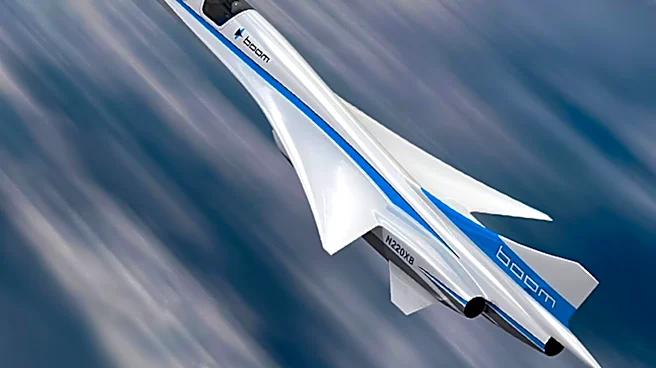
This successful engine core test is crucial for Boom Supersonic's ambitious plans to reintroduce supersonic commercial flight and diversify into the energy sector. Developing its own engine, named Symphony, is a monumental undertaking that addresses a key challenge after previous partnerships fell through. The dual application of the engine core—for the Overture airliner and for Superpower gas turbines for AI data centers—highlights an innovative strategy to fund the capital-intensive aerospace venture. The demand for electricity from AI data centers presents a significant market opportunity, potentially providing a revenue stream that supports the development and certification of the Overture. Success in this area could establish Boom as a unique player capable of both aircraft and engine manufacturing, a rare feat in the aviation industry. The Overture aims to cruise at Mach 1.7, carrying 60-80 passengers at business-class fares, potentially halving current transatlantic flight times.
What's Next?
Boom Supersonic plans to continue extensive testing of the engine core over the coming months, pushing its performance further. The company expects to test the fully integrated Symphony engine, which will wrap the core in a fan to produce approximately 40,000 lb of thrust, around mid-2027. Concurrently, Boom will also develop the Superpower gas turbine for AI data centers, which shares over 75% of its parts with Symphony. First deliveries of the Superpower turbines are anticipated in mid-2027, with Boom aiming to build 25 turbines annually by 2028 and 50 by 2029. While the official target for Overture's entry into service was 2029, recent statements from United CEO Scott Kirby and Boom's CEO Blake Scholl suggest a potential delay of one to two years. The operational experience and reliability data gathered from Superpower's service are expected to inform and accelerate Symphony's development.
Beyond the Headlines
The development of Boom's proprietary engine core signifies a broader trend of vertical integration within the aerospace industry, particularly for companies pursuing disruptive technologies. By taking on engine development in-house, Boom aims to mitigate risks associated with supplier dependencies and gain greater control over its product's performance and timeline. This strategy, while challenging, could lead to more optimized and integrated systems for supersonic flight. Furthermore, Boom's foray into providing gas turbines for AI data centers illustrates a creative approach to funding high-risk, high-reward aerospace projects. This diversification could establish a new model for aerospace innovation, where adjacent market opportunities are leveraged to support core product development. The success of this dual-pronged strategy could influence how future advanced aerospace projects are financed and executed, potentially fostering more independent and integrated development cycles.