







What's Happening?
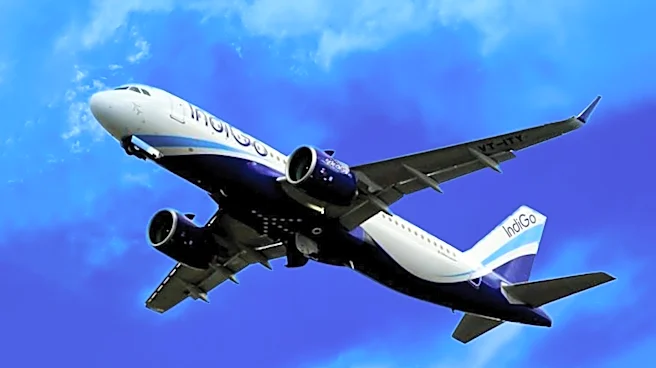
IndiGo CEO Willie Walsh has stated that the airline sees significant opportunities despite the current challenges facing the aviation industry. During his first in-person briefing since assuming the CEO role in August, Walsh emphasized the airline's commitment
to maintaining an excellent cost base. He announced that IndiGo anticipates receiving its first wide-body Airbus A350 aircraft starting from the second quarter of 2028. These A350s will feature a three-class configuration, including 16 flat beds in business class, premium economy, and economy seats, with this configuration locked for the initial 10 aircraft. Walsh acknowledged the difficult operating environment, particularly due to rising fuel costs, which contributed to IndiGo reporting a loss of Rs 1,879.1 crore in the September quarter. The airline also reduced capacity in response to these pressures. Despite these headwinds, Walsh expressed confidence in IndiGo's ability to succeed in the long-haul market and highlighted the Navi Mumbai airport as a major opportunity for the airline, leading to a partial shift of international flights there.
Why It's Important?
This announcement is significant for the U.S. aviation industry and global travel, as IndiGo's expansion into the long-haul market with A350 aircraft could intensify competition on international routes. Increased competition often leads to more competitive pricing and potentially more diverse flight options for consumers. For U.S. airlines, this could mean a need to re-evaluate their strategies for routes connecting to India and other Asian markets. The focus on a three-class configuration, including flat beds in business class, indicates a move towards capturing a larger share of premium travelers, a segment often targeted by established international carriers. Furthermore, IndiGo's ability to navigate rising fuel costs and currency depreciation, while still planning significant expansion, provides insights into resilience strategies within the global airline sector. The decision to utilize the Navi Mumbai airport also points to evolving aviation hubs and their potential impact on global air traffic patterns.
What's Next?
IndiGo is set to begin receiving its wide-body Airbus A350 aircraft from the second quarter of 2028, marking a pivotal step in its long-haul expansion strategy. The airline will continue to focus on managing its cost base to mitigate the impact of fluctuating fuel prices and currency depreciation. While there are no immediate plans for fuel price hedging, the option will be revisited after a policy is finalized. The initial 10 A350 aircraft will have a fixed three-class configuration, but IndiGo may consider increasing the number of flat beds in business class for subsequent deliveries. The airline will also proceed with its strategy to partly shift international flights to the Navi Mumbai airport, leveraging its perceived opportunities. The industry will be watching how IndiGo's expansion affects market dynamics, particularly in the long-haul segment, and how it manages profitability amidst ongoing operational challenges.
Beyond the Headlines
IndiGo's strategic move into the long-haul international market with wide-body aircraft represents a broader trend in the global aviation industry where low-cost carriers are increasingly challenging traditional full-service airlines on longer routes. This shift could lead to a redefinition of 'value' in international air travel, pushing all carriers to innovate in service offerings and cost efficiency. The emphasis on a strong cost base, even amidst expansion, highlights the persistent economic pressures in the airline sector and the importance of operational efficiency. The airline's confidence in 'incredible opportunities' despite significant losses and industry challenges also reflects a long-term view of market growth, particularly in emerging economies. This expansion could also have environmental implications, as newer, more fuel-efficient aircraft like the A350 are introduced, potentially contributing to reduced emissions per passenger mile, though overall air travel growth remains a concern for climate advocates.