






What's Happening?
Dell Technologies has expanded its AI Data Platform with new features aimed at helping enterprises move AI projects from pilot to production more efficiently. The enhancements include business context for agent-based AI, accelerated data preparation powered
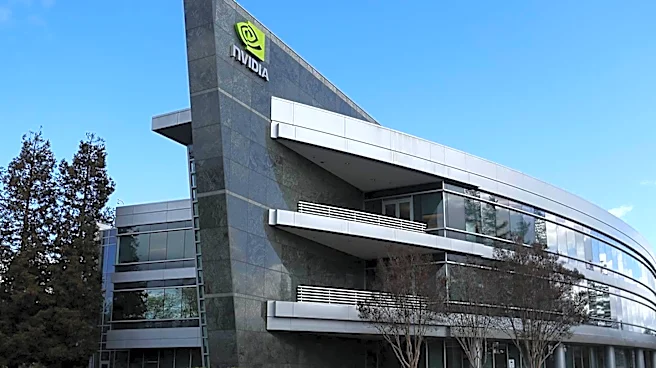
by Nvidia, multi-tenancy capabilities, storage performance measurement tools, a managed PowerScale service for Microsoft Azure, and professional services. According to Varun Chhabra, Senior Vice President of Marketing for Dell's ISG Solutions Group, a recent Dell survey indicates that 53% of business and IT decision-makers prioritize building and scaling AI capabilities in the next 24 months, yet half lack a clear roadmap for AI, data, and security. The core problem identified is the fragmentation of enterprise data across various environments, which delays implementations and limits the return on AI investments. Dell's updated platform integrates Nvidia cuDF for accelerated processing, GPU-accelerated Apache Spark for data preparation, and Apache Arrow for efficient data transfer, leading to significantly faster data processing compared to CPU-only methods.
Why It's Important?
This strategic move by Dell is crucial for the broader U.S. enterprise sector as it directly addresses a significant hurdle in AI adoption: the gap between AI pilot projects and full-scale production. By providing a more streamlined and accelerated data pipeline, Dell aims to unlock the full potential of AI for businesses, enabling them to leverage their data more effectively for generative AI agents and other advanced applications. The integration of Nvidia's accelerated computing capabilities means that companies can utilize their GPU infrastructure for both model execution and data processing, optimizing resource utilization and potentially reducing operational costs. This development could significantly impact industries reliant on large datasets and complex AI models, such as finance, healthcare, and manufacturing, by making AI more accessible and performant. Furthermore, the emphasis on data governance and security across the platform is vital for enterprises dealing with sensitive information, fostering trust and compliance in AI deployments.
What's Next?
Dell plans to introduce further developments to its AI Data Platform roadmap in approximately one month, which may include new partner certifications and training programs to support the expanded functionalities. The company anticipates that these enhancements will enable sales partners to move beyond mere infrastructure sales and become trusted advisors in solving complex data problems for their clients. The managed PowerScale service for Microsoft Azure, initially available in the Azure East US region, is expected to expand, offering more enterprises the benefits of PowerScale's performance and resilience in a public cloud environment. As the AI landscape continues to evolve rapidly, Dell's ongoing focus on providing context for generative AI agents to improve accuracy and reduce 'hallucinations' suggests a continuous effort to refine AI outputs and increase their reliability for business applications. The open-source Storage Performance Tool will also empower companies to conduct realistic AI workload testing on their own infrastructure, moving away from sole reliance on vendor benchmarks.
Beyond the Headlines
The deeper implication of Dell's enhanced AI Data Platform lies in its potential to democratize advanced AI capabilities for a wider range of enterprises. By simplifying the complex process of data preparation and management for AI, Dell is effectively lowering the barrier to entry for companies that may have previously lacked the specialized expertise or infrastructure to implement large-scale AI projects. The focus on creating a unified semantic layer and enterprise knowledge graph for AI agents highlights a shift towards more context-aware and intelligent AI systems, which could lead to more accurate and reliable AI-driven insights. This could also foster a more competitive AI market by enabling more businesses to develop and deploy sophisticated AI solutions. The collaboration with Nvidia further solidifies the trend of hardware and software integration as a key driver for AI innovation, emphasizing the importance of optimized ecosystems for maximizing AI performance and efficiency.