




What's Happening?
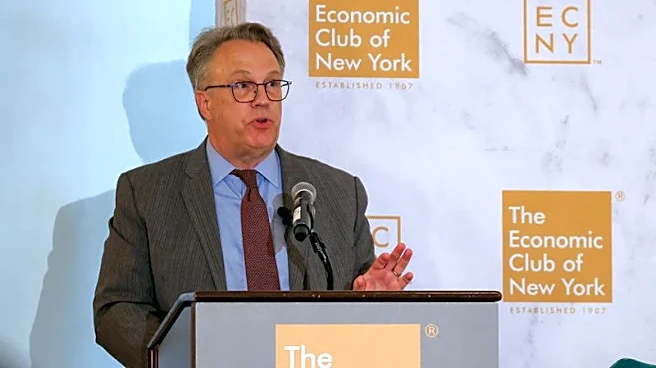
Federal Reserve Bank of New York President John Williams stated that the central bank still has significant work ahead to control persistent inflation. Speaking at an event in New York, Williams underscored the necessity of taking sustained actions to bring
inflation back to the Federal Reserve's target of 2%. His remarks highlight the ongoing commitment of the Federal Reserve to address rising prices and stabilize the economy. This statement comes amidst broader concerns about inflation, which has remained elevated, prompting various Federal Reserve officials to comment on the need for decisive measures. The central bank's strategy involves a series of policy adjustments aimed at moderating economic activity to curb inflationary pressures.
Why It's Important?
President Williams's comments are crucial as they signal the Federal Reserve's unwavering focus on its inflation target, directly impacting U.S. economic stability. Persistent inflation erodes purchasing power for consumers and creates uncertainty for businesses, affecting investment and growth. The Federal Reserve's actions, guided by officials like Williams, influence interest rates, which in turn affect borrowing costs for mortgages, car loans, and business investments. A sustained effort to reduce inflation to 2% is vital for maintaining economic health, ensuring price stability, and fostering a predictable environment for both households and corporations. Failure to achieve this target could lead to prolonged economic challenges, impacting employment and overall market confidence.
What's Next?
The Federal Reserve is expected to continue implementing monetary policy measures designed to bring inflation down to its 2% target. This likely includes further adjustments to interest rates and other quantitative tools, as deemed necessary by economic data. Stakeholders, including financial markets, businesses, and consumers, will closely monitor upcoming economic reports, such as the Consumer Price Index, and statements from Federal Reserve officials for indications of future policy directions. The central bank's approach will be data-dependent, meaning that the pace and magnitude of future actions will be determined by evolving economic conditions and inflation trends. The goal is to achieve a 'soft landing' where inflation is controlled without triggering a severe economic downturn.
Beyond the Headlines
The Federal Reserve's ongoing battle against inflation extends beyond immediate economic indicators, touching upon the broader public's trust in economic institutions. Sustained high inflation can lead to a loss of confidence in the currency and the central bank's ability to manage the economy, potentially fostering social and political unrest. The challenge for the Federal Reserve is to balance the need for aggressive action against inflation with the risk of triggering a recession. This delicate balancing act involves not only economic modeling but also careful communication to manage public expectations and maintain market stability. The long-term implications of current policy decisions will shape the economic landscape for years, influencing everything from wage growth to international trade relations.