







What's Happening?
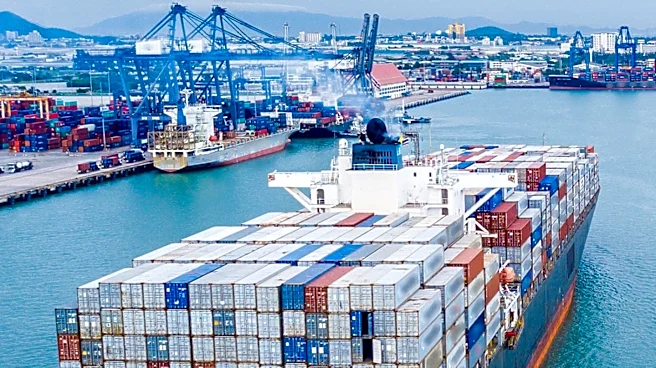
The container shipping industry is on the brink of a significant overcapacity issue, with a large number of new vessels scheduled for delivery that may not be met by sufficient global trade demand. According to a Sea-Intelligence analysis of the International
Monetary Fund’s (IMF) World Economic Outlook, global trade volume growth is projected to stabilize from 4.6 percent this year to 4.7 percent in 2027. However, import growth in advanced economies is expected to soften from 5 percent in 2026 to 4.2 percent in 2027. Despite this, container shipping companies are aggressively ordering new ships, driven by factors such as longer routes, port congestion absorbing existing capacity, and a desire for larger, more environmentally friendly vessels. Industry consultancy Linerlytica reports that global vessel orders total 16.2 million 20-foot equivalent units (TEUs), representing 46.5 percent of the current global fleet. Alphaliner indicates that approximately 1,000 new ships, totaling 8.5 million TEUs, are expected to enter the market in 2027 and 2028, with further deliveries planned for 2029 and 2030.
Why It's Important?
This potential overcapacity poses a significant challenge for the U.S. and global shipping industry, impacting freight rates, profitability for carriers, and the overall efficiency of supply chains. A surplus of vessel capacity without a corresponding increase in cargo demand could lead to downward pressure on shipping costs, which might benefit importers and consumers in the short term but could destabilize the financial health of shipping companies. The current ordering spree by major carriers like Mediterranean Shipping Company (MSC), Maersk, Cosco Shipping, and CMA CGM, while aimed at modernizing fleets and improving emissions profiles, risks creating an imbalance. The situation is further complicated by geopolitical factors, such as potential normalization of traffic through the Strait of Hormuz and a wider return to the Suez Canal, which could release even more effective capacity into the market. This scenario could force carriers to implement measures like slower sailing speeds or blank sailings to manage capacity, affecting delivery times and logistical planning for businesses reliant on international trade.
What's Next?
The container shipping industry will need to closely monitor global trade growth and adjust its strategies to mitigate the impact of impending vessel deliveries. Carriers may increasingly resort to operational levers such as slower sailing speeds and blank sailings to absorb excess capacity, as suggested by BIMCO, which expects slower speeds alone to absorb about 1 percentage point of fleet growth in both 2026 and 2027. However, these measures do not remove tonnage from the fleet permanently, meaning capacity can quickly return if market conditions change. The lack of significant vessel demolitions, with ships aged 20 years or older accounting for only 16 percent of the fleet, further limits options for reducing supply. Stakeholders, including shippers, freight forwarders, and port authorities, will need to prepare for potential fluctuations in freight rates and service reliability as the industry navigates this period of significant fleet expansion relative to demand.
Beyond the Headlines
The looming overcapacity in container shipping highlights a broader tension between short-term operational needs and long-term strategic investments in the maritime sector. While carriers are investing in new, more efficient, and cleaner vessels to meet environmental regulations and optimize routes, the timing of these deliveries against a backdrop of slowing global trade growth creates a precarious situation. The shift in global supply chains, where manufacturers are rerouting production through intermediate countries like Vietnam, Malaysia, and Indonesia to circumvent tariffs, further complicates the demand picture. This practice, while maintaining overall trade volumes, increases logistical complexity and costs, potentially impacting the efficiency gains from new, larger vessels. Furthermore, the rise of high-value, low-weight goods like AI hardware, which contribute significantly to trade value but minimally to physical cargo volume, underscores a fundamental disconnect between economic growth and traditional shipping demand metrics, posing a long-term challenge for the industry's capacity planning.