
What's Happening?
Nuro, a privately held technology company based in Mountain View, CA, is actively recruiting a Machine Learning Research Scientist specializing in Prediction & Smart Agents. Founded in 2016, Nuro focuses on developing Level 4 autonomous driving technology,
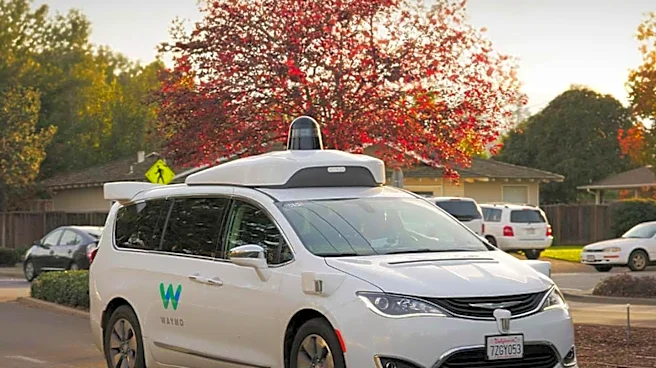
which includes its universal autonomy platform, Nuro Driver™. This platform is designed to enable the deployment of autonomy across various applications, from robotaxis and logistics fleets to personal vehicles. The company has secured over $2 billion in funding from prominent investors such as Uber, NVIDIA, Google, SoftBank, Fidelity, and T. Rowe Price. The new role involves designing and building scalable, machine learning-based prediction systems to generate realistic and kinematically feasible trajectories for autonomous vehicles. This includes conducting research in generative sequence modeling and sequential decision-making, with a focus on areas like transformer-based architectures and large generative models. The scientist will also collaborate with the Planning team to develop controllable agents for closed-loop simulation and address challenges in autonomous driving by exploring novel machine learning methods.
Why It's Important?
This recruitment highlights Nuro's continued investment in advanced artificial intelligence and machine learning to enhance its autonomous driving capabilities. The development of more sophisticated prediction systems is crucial for the safety and reliability of self-driving vehicles, directly impacting their widespread adoption and integration into daily life. Improved prediction models allow autonomous systems to better anticipate the behavior of other road users, leading to safer and more efficient navigation. This advancement could accelerate the deployment of autonomous vehicles in various sectors, including logistics and ride-sharing, potentially transforming urban mobility and delivery services across the U.S. The success of Nuro's technology could also influence regulatory frameworks and public perception of autonomous vehicles, fostering a more connected and accessible future. Furthermore, the company's substantial funding from major tech and investment firms underscores the significant economic interest and potential for growth within the autonomous vehicle industry.
What's Next?
The successful candidate will be instrumental in advancing Nuro's core autonomous driving technology, specifically in the area of predicting traffic behavior. This will involve deploying cutting-edge machine learning models onto real-world vehicles and integrating them into the company's planning stack. The research and development in generative sequence modeling and sequential decision-making are expected to lead to more robust and adaptable autonomous systems. Nuro aims to continue expanding its universal autonomy platform, Nuro Driver™, to support a broader range of vehicles and use cases. The company's ongoing efforts are geared towards making everyday life safer, easier, and more connected through autonomous technology. Future developments will likely include further collaborations with partners in the mobility ecosystem to scale the deployment of autonomous solutions.
Beyond the Headlines
The pursuit of advanced machine learning for autonomous driving raises significant ethical and legal considerations, particularly concerning decision-making in complex and unpredictable scenarios. The ability of AI to predict human behavior on roads, while crucial for safety, also brings questions about accountability in the event of accidents. As Nuro and similar companies push the boundaries of Level 4 autonomy, the legal frameworks surrounding liability and responsibility will need to evolve. Culturally, the widespread adoption of autonomous vehicles could lead to shifts in urban planning, transportation infrastructure, and employment within the logistics and transportation sectors. The integration of AI into physical systems like vehicles also highlights the broader trend of artificial intelligence moving beyond digital interfaces into tangible, real-world applications, prompting discussions about human-AI interaction and trust in automated systems.