






What's Happening?
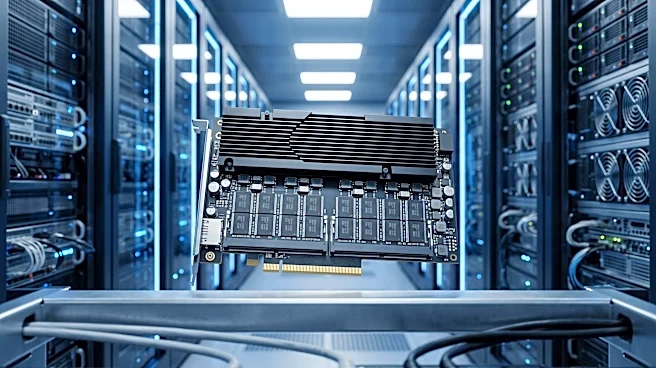
Marvell Technology has announced its second-generation Marvell Structera X 3406 and Marvell Structera X 3506 CXL memory expanders. These new devices are designed to enhance the efficiency, scalability, and performance of cloud, enterprise, and AI infrastructure
systems. The expanders feature six DDR4/DDR5 channels, a 50% increase from the previous generation, and incorporate PCIe Gen 6 connectivity. This allows for greater memory bandwidth and capacity, supporting up to 9TB of DDR4 or 6TB of DDR5 per controller. The Structera X 3406/3506 also introduces industry-first four-host connectivity, enabling memory capacity sharing among up to four hosts and providing up to 256GB/s PCIe6.0 x16 of host bandwidth. Additionally, the new expanders offer 5x higher LZ4 compression throughput, delivering up to 2-3x more effective memory capacity and 40-50% faster time to first token for AI inference workloads. Marvell will showcase these solutions at the OCP Global Summit 2026, with sampling expected in Q1 2027.
Why It's Important?
The introduction of Marvell's second-generation CXL memory expanders is crucial for addressing the escalating memory demands of modern AI and machine learning workloads, particularly large language models (LLMs). Traditional server architectures are struggling to keep pace with the growing sizes of LLMs, expanding context windows, and increasing KV-cache requirements, making memory a critical bottleneck for AI performance and infrastructure efficiency. By significantly increasing memory bandwidth and capacity, these new expanders will enable AI servers to handle larger models and longer context windows more effectively. The multi-host sharing capability and enhanced compression throughput will improve memory utilization and efficiency across AI clusters, which is vital for hyperscale data centers looking to optimize their AI infrastructure performance as workloads become more complex. This innovation helps mitigate the 'AI memory wall,' a significant challenge where accelerator compute has scaled faster than memory capacity and bandwidth, ultimately leading to more efficient and cost-effective AI operations.
What's Next?
Marvell Technology plans to sample the Structera X 3406 and 3506 CXL memory expanders in Q1 2027. The company will also present its full portfolio of AI data center infrastructure solutions, including these new memory expanders, at the OCP Global Summit 2026 from October 12-15. This event will serve as a key platform for Marvell to demonstrate its advancements to hyperscale operators and cloud builders, who are critical in adopting new hardware specifications for AI data centers. The market will closely watch how these new memory expanders are integrated into next-generation AI systems and how they influence the design and efficiency of large-scale AI deployments. Continued collaboration with CPU and memory vendors, OEMs, ODMs, and system integrators will be essential for the widespread adoption and ecosystem integration of these CXL solutions, further solidifying Marvell's position in the evolving AI infrastructure landscape.
Beyond the Headlines
The development of advanced CXL memory expanders like Marvell's Structera X series signifies a broader shift in how data centers are architected for the AI era. As AI models become more sophisticated and data-intensive, the focus is moving beyond raw compute power to optimizing the entire data infrastructure, including memory, storage, and connectivity. The ability to pool and share memory resources across multiple hosts, coupled with improved compression, addresses not only performance bottlenecks but also economic considerations. With memory prices rising, the capacity to repurpose older DDR4 DIMMs into DDR5 systems via CXL offers significant cost savings for hyperscale buyers. This modular approach to AI infrastructure, where components like switching fabric, memory pooling, and optical interconnects are optimized as a unified system, fosters greater supplier choice and competition. This could lead to more rapid innovation and better pricing for cloud providers, ultimately impacting the accessibility and efficiency of AI technologies across various industries.