




What's Happening?
Rev Lebaredian, Vice President of Omniverse and Simulation Technology at NVIDIA, participated in the Synopsys Converge Executive Forum. The session focused on 'Physical AI and the future of Systems Design.' This event brought together experts from various
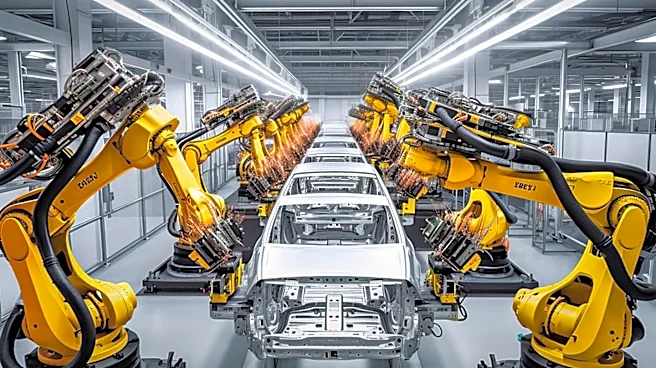
companies, including Synopsys, NVIDIA, Arm, and Schaeffler, to discuss the evolving landscape of intelligent systems. The core theme revolved around how physical AI is transforming interactions between intelligent systems and the real world, impacting areas such as autonomous vehicles, humanoid robots, smart manufacturing, and digital twins. The discussion highlighted the convergence of AI, simulation, and advanced engineering in creating systems capable of perceiving, reasoning, and acting autonomously. Lebaredian, representing NVIDIA, contributed to the exploration of how simulation-driven design and co-optimization across hardware, software, and physics-based models are accelerating the future of intelligent systems.
Why It's Important?
The discussions at the Synopsys Converge Executive Forum, featuring NVIDIA's Rev Lebaredian, underscore a significant shift in the development of intelligent systems within the U.S. technology sector. The emphasis on 'Physical AI' signifies a move beyond purely digital AI applications to systems that interact directly with the physical world. This has profound implications for industries reliant on automation and advanced robotics, such as manufacturing, logistics, and transportation. U.S. companies investing in these areas stand to gain a competitive edge by integrating AI with real-world physical interactions, leading to more efficient and autonomous operations. Conversely, businesses that fail to adapt to these advancements risk falling behind. The collaboration between major tech players like NVIDIA and Synopsys in this domain highlights a collective effort to drive innovation that could reshape numerous U.S. industries and create new economic opportunities.
What's Next?
The ongoing dialogue and collaboration among industry leaders like Rev Lebaredian from NVIDIA at forums such as the Synopsys Converge Executive Forum suggest a continued acceleration in the development and deployment of physical AI technologies. Future developments are likely to include more sophisticated autonomous systems, enhanced digital twin capabilities for industrial applications, and further integration of AI into robotics. Companies will likely increase their investments in research and development in these areas, leading to new product offerings and services. The insights shared at such events will likely influence strategic decisions for technology companies, potentially leading to new partnerships, mergers, and acquisitions aimed at consolidating expertise and market share in the burgeoning physical AI sector. The focus on co-optimization across hardware, software, and physics-based models indicates a trend towards more holistic and integrated system designs.
Beyond the Headlines
The emergence of physical AI, as discussed by Rev Lebaredian and other experts, extends beyond mere technological advancement; it raises fundamental questions about the future of human-machine interaction and the ethical implications of increasingly autonomous systems. As AI-powered robots and autonomous vehicles become more prevalent in the physical world, considerations around safety, accountability, and job displacement will become increasingly critical. The development of robust simulation and co-optimization techniques is not just about efficiency but also about ensuring the reliability and predictability of these complex systems in real-world scenarios. Furthermore, the push for physical AI could lead to a redefinition of skilled labor, requiring a workforce capable of designing, maintaining, and interacting with these advanced intelligent machines. This technological shift could also influence public policy, prompting new regulations and standards for the deployment and operation of physical AI across various sectors.