






What's Happening?
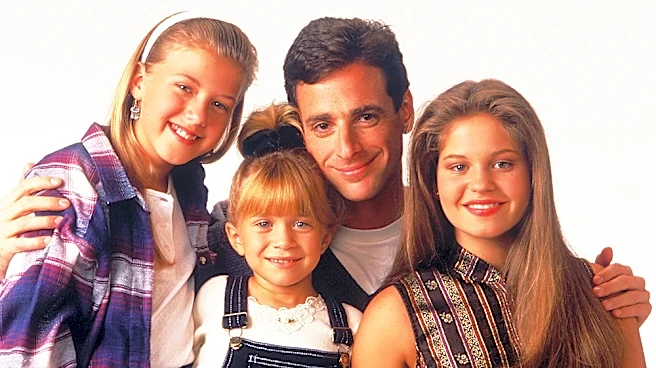
Candace Cameron Bure, known for her role as D.J. Tanner in 'Full House' and 'Fuller House,' has stated that she receives 'substantial' residual checks from the long-running sitcom. Her comments come after her co-star, Jodie Sweetin, publicly revealed
receiving a residual check for only one cent from the same show. Bure indicated that her checks are issued quarterly and she is consistently pleased with the amounts. She also noted that she receives residual checks from a wide array of projects throughout her career, including pre-'Full House' work, post-'Full House' roles, and numerous Hallmark movies. While some of these smaller checks can be for minimal amounts like two cents or a few dollars, she emphasized that the 'Full House' residuals remain significant. Bure suggested that Sweetin should investigate the matter with her agent or bank, as Bure herself continues to receive considerable payments.
Why It's Important?
This disparity in residual payments highlights a significant and ongoing issue within the entertainment industry, particularly concerning the shift from traditional syndication to streaming platforms. Historically, actors received substantial compensation from reruns on cable and DVD sales. However, with the rise of streaming services, the payment structures for residuals have changed, often resulting in significantly lower or non-existent payments for many performers. Bure's experience suggests that some actors, particularly those with extensive careers and specific contract terms, may still benefit from older agreements or different arrangements. Conversely, Sweetin's situation reflects the challenges many actors face in the streaming era, where projects can garner massive viewership without commensurate residual payments. This issue was a central point of contention during recent SAG-AFTRA strikes, underscoring the need for updated compensation models that reflect the current media landscape and ensure fair pay for artists.
What's Next?
The differing experiences of Candace Cameron Bure and Jodie Sweetin regarding 'Full House' residuals may prompt further discussion within the acting community about the nuances of residual payments in the streaming era. It could encourage other actors to review their own residual statements and contractual agreements, especially for shows that have transitioned to streaming platforms. Industry unions like SAG-AFTRA may use such examples to continue advocating for stronger protections and more equitable compensation structures for actors in streaming deals. This situation might also lead to increased transparency from studios and streaming services regarding how residuals are calculated and distributed. Individual actors, following Bure's advice, may be more inclined to consult with their agents and financial advisors to understand and potentially challenge discrepancies in their residual payments.
Beyond the Headlines
The contrasting residual experiences of these two 'Full House' stars underscore a broader economic transformation in Hollywood, moving from a model based on traditional broadcast and syndication to one dominated by streaming. This shift has profound implications for actors' long-term financial stability, particularly for those whose careers are built on successful television series. The 'one-cent check' phenomenon, while seemingly minor, symbolizes a systemic issue where content creators may not fully benefit from the continued popularity and profitability of their work on new platforms. This situation raises ethical questions about fair compensation in an evolving media landscape and highlights the power imbalance between major studios/streamers and individual performers. It also brings to light the varying degrees of financial literacy and advocacy available to actors, with some potentially better equipped to navigate complex contractual landscapes than others.