






What's Happening?
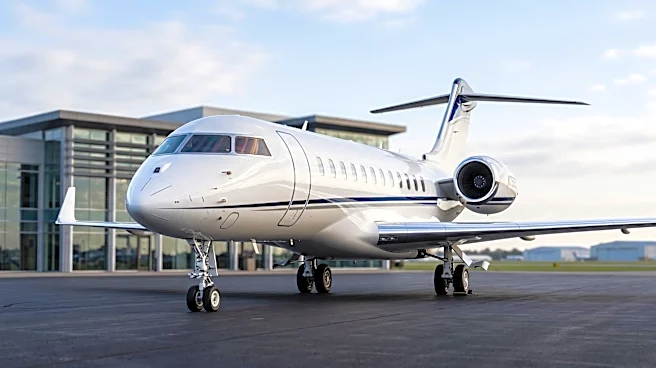
Jim Segrave, founder of private jet company FlyExclusive, is implementing artificial intelligence to significantly enhance operational efficiency and customer experience. The company, which operates 72 jets and averages around 200 flights daily, aims
to leverage AI to save time, which directly impacts performance and profitability. Key AI initiatives include a 'Blue Dot Revolution' system that provides precise directions to specific fixed-base operations, alerts pilots of customer arrival, and facilitates photo exchanges between pilots and customers. Additionally, Segrave has developed a personal AI assistant for himself and is working on a fully automated booking system that handles trip requests, pricing, TSA checks, and billing without human involvement. AI is also being integrated into sales to provide real-time information and standardize salesperson interactions.
Why It's Important?
This integration of AI in private aviation is important as it demonstrates a significant shift towards automation and data-driven decision-making in a high-stakes industry. By optimizing flight operations, customer interactions, and sales processes, FlyExclusive aims to achieve substantial time savings and efficiency gains. This could set a new standard for customer service and operational excellence in private jet travel, potentially influencing other sectors of the aviation industry. The ability to grow the business without proportionally increasing headcount, as Segrave predicts, highlights AI's potential to drive scalability and profitability. This move also underscores the competitive advantage that early and effective AI adoption can provide, forcing competitors to consider similar technological advancements to remain relevant.
What's Next?
FlyExclusive plans to continue expanding its AI implementation, with Segrave noting that the timeline for these advancements has shortened from years to months. The company's proprietary flight management system, Contrails FMS, will serve as the backbone for these AI-driven operations, automating approximately 90% of tasks and allowing human staff to focus on complex problem-solving. The success of FlyExclusive's AI initiatives could lead to broader adoption of similar technologies across the private aviation sector and potentially influence commercial aviation. Future developments will likely include further refinement of the automated booking system, enhanced AI-powered sales tools, and continuous optimization of flight operations to maximize efficiency and customer satisfaction.
Beyond the Headlines
Beyond the immediate business benefits, FlyExclusive's AI adoption raises broader questions about the future of work and human-machine collaboration in specialized industries. While AI is automating many routine tasks, Segrave emphasizes that it won't replace the human element in high-stakes sales or critical decision-making, but rather augment human capabilities. This approach suggests a model where AI acts as a powerful assistant, enabling human employees to be more effective and focus on higher-value activities. The rapid pace of AI development, as noted by Segrave, also highlights the need for businesses to adapt quickly to technological changes to maintain a competitive edge. This transformation could lead to new skill requirements for aviation professionals and a redefinition of roles within the industry.