







What's Happening?
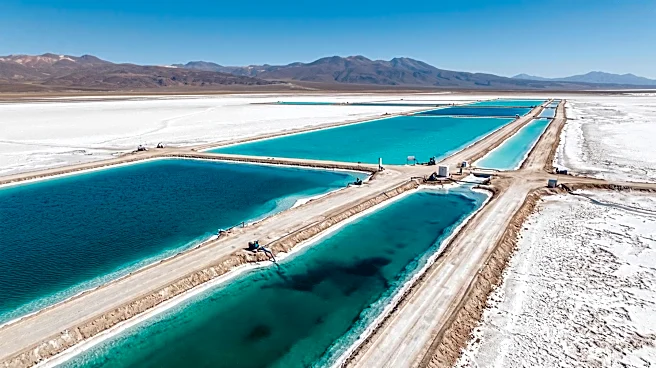
The American mining company Albemarle has been ordered to pay a fine of approximately US$4.18 million for environmental violations at its lithium operation in the Salar de Atacama, Chile. The First Environmental Court rejected Albemarle's appeal and upheld
the sanction imposed by the Superintendence of the Environment (SMA). The violations primarily concern brine extraction: exceeding the authorized volume between October 2019 and September 2020 by 324,395 cubic meters, and a significant delay in reducing pumping after an environmental alert was triggered in February 2021. This delay resulted in an over-extraction of 639,517 cubic meters during February and March 2021. The ruling emphasizes the critical importance of adhering to extraction limits and alert mechanisms in the environmentally sensitive salt flats, which are closed water systems vital for local ecosystems and communities.
Why It's Important?
This ruling against Albemarle is significant for the U.S. mining industry and global environmental governance, particularly concerning critical minerals like lithium. It underscores the increasing scrutiny and enforcement of environmental regulations for resource extraction, even in foreign operations of U.S. companies. For Albemarle, a major player in the lithium market, the fine represents a financial penalty and a reputational risk, potentially impacting investor confidence and future project approvals. More broadly, it sets a precedent for other U.S. and international mining companies operating in ecologically sensitive regions, signaling that environmental compliance will be rigorously enforced. This could lead to higher operational costs for companies as they invest more in monitoring and sustainable practices, but it also promotes responsible mining and protects vital ecosystems. The case highlights the tension between the growing global demand for lithium, essential for electric vehicles and renewable energy, and the environmental impact of its extraction.
What's Next?
Albemarle will be required to pay the US$4.18 million fine. The company will also face increased scrutiny regarding its environmental practices in the Salar de Atacama and potentially in other regions where it operates, such as Argentina's Salar de Antofalla. The ruling may prompt Albemarle and other lithium miners to re-evaluate and strengthen their environmental monitoring systems and response protocols to avoid future violations. There will likely be a continued focus on developing and implementing more sustainable lithium extraction technologies, such as Direct Lithium Extraction (DLE), which aims to reduce brine extraction and reincorporate processed liquid back into the system. Regulators in other countries with similar salt flat ecosystems, including Argentina, may look to this case as a model for enforcing their own environmental protections, potentially leading to stricter regulations across the industry.
Beyond the Headlines
This case illuminates the complex ethical and environmental challenges inherent in the global pursuit of critical minerals for the green energy transition. While lithium is crucial for electric vehicles and renewable energy storage, its extraction, particularly from brine in arid regions, poses significant risks to water resources and delicate ecosystems. The ruling against Albemarle highlights a broader societal debate about balancing technological advancement and environmental preservation. It also brings to light the concept of 'environmental justice' in resource-rich but often economically vulnerable regions, where local communities and ecosystems bear the brunt of industrial activities. The long-term implications could include a shift towards more localized and sustainable supply chains for critical minerals, increased investment in recycling technologies, and a greater emphasis on corporate social responsibility and transparent environmental reporting within the mining sector.