


What's Happening?
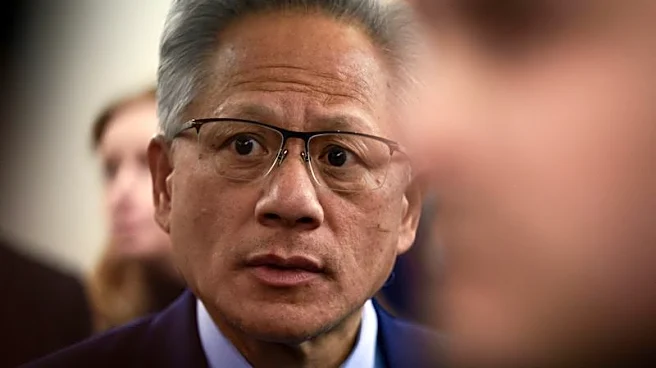
Leading semiconductor research firm SemiAnalysis suggests that the departure of Nvidia CEO Jensen Huang may be linked to widespread illicit exports of advanced AI accelerators to China. Analysts estimate that over 1.5 gigawatts (GW) worth of restricted
Nvidia hardware, potentially equivalent to up to 1.5 million GPUs, has reached China despite U.S. export controls. This estimate excludes processors specifically designed to comply with U.S. rules, such as the H20 or H800. The U.S. Department of Commerce reportedly reached a similar conclusion regarding the scale of unauthorized shipments. Two specific cases of alleged GPU smuggling are highlighted: one involving Supermicro co-founder Wally Liaw and others diverting equipment to China via Southeast Asia, and another involving individuals associated with Nvidia and other companies arranging unauthorized exports of B300-based servers to China.
Why It's Important?
The alleged mass smuggling of advanced AI chips to China represents a significant breach of U.S. export controls, which are designed to protect American technological leadership and national security. The scale of these diversions, comparable to or exceeding the computing infrastructure of major AI projects, could significantly bolster China's AI capabilities, potentially enabling the development of sophisticated AI models that rival those in the U.S. This situation raises serious concerns about the effectiveness of current export control mechanisms and the potential for U.S. technology to be used in ways that undermine American interests. For Nvidia, the implications are substantial, including potential corporate liability for export control violations and damage to its reputation. The controversy also highlights the intense geopolitical competition in the AI sector and the challenges of controlling the flow of critical technologies.
What's Next?
The revelations are likely to trigger intensified investigations by U.S. authorities into the alleged smuggling networks and the involvement of individuals and companies. This could lead to further indictments and legal actions against those found to be in violation of export control laws. The U.S. government is expected to review and potentially strengthen its export control policies, possibly including measures to track the end-use of advanced AI hardware more rigorously. The timing of Jensen Huang's departure suggests a potential shift in Nvidia's approach to the Chinese market and its compliance with U.S. regulations. Furthermore, the ongoing congressional efforts to advance legislation like the Remote Access Security Act (RASA) indicate a move towards extending U.S. export-control authority to remote access of AI hardware hosted outside China, which could significantly impact how Chinese entities access compute power globally.
Beyond the Headlines
The alleged mass smuggling underscores the immense demand for advanced AI chips in China and the lengths to which entities may go to acquire them. This situation highlights the dual-use nature of AI technology, where powerful chips can drive both economic innovation and potentially military or surveillance applications. The debate over whether to completely restrict China's access to U.S. AI hardware or allow controlled access under oversight is critical. While complete restrictions could encourage China to develop its own domestic chip industry, potentially creating a future competitor, controlled access could generate revenue for U.S. companies and allow for monitoring. This complex interplay of economic interests, national security, and technological advancement will continue to shape U.S.-China relations and the global AI landscape.