






What's Happening?
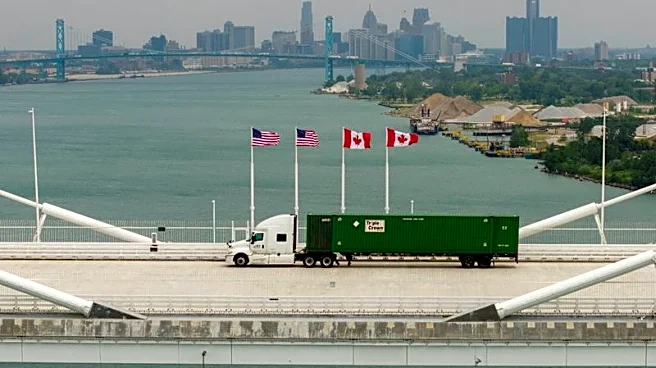
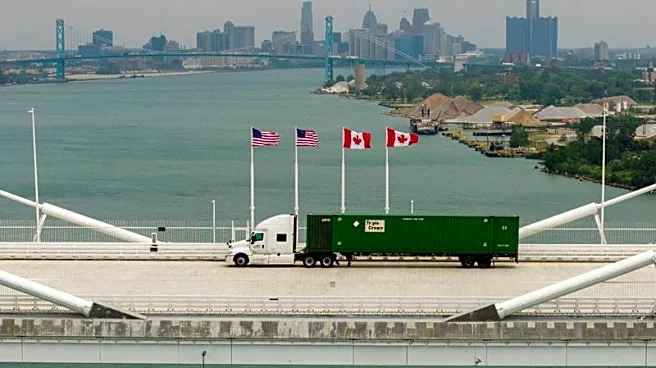
The Trump administration has levied 50% tariffs on approximately $20 billion worth of Canadian goods following the collapse of last-minute trade negotiations. The affected products span a wide range, including plywood, liquor, electrical equipment, furniture,
food products, and hockey equipment, representing about 5% of Canada's exports to the U.S. This move was unexpected, as Washington and Ottawa were reportedly close to a deal just days prior. U.S. Trade Representative Jamieson Greer stated that Canada 'upended the careful balance' achieved during negotiations. In response, Canadian Prime Minister Mark Carney has pledged 'dollar for dollar' retaliation, set to begin on September 8, targeting U.S. products such as steel, dairy, electronics, appliances, and agricultural equipment. This marks a significant escalation in trade tensions between the two North American partners.
Why It's Important?
This tariff imposition and the promised retaliation carry significant implications for both the U.S. and Canadian economies. For the U.S., several sectors face potential exposure, including steel mills, dairy farmers, electronics manufacturers, consumer-goods companies, machinery manufacturers, and beverage producers. The timing is particularly critical as inflation remains a concern, and a new round of tariffs could increase input costs for businesses and consumers already grappling with higher prices. While the initial $20 billion in targeted Canadian goods is a fraction of the total trade volume, the risk lies in the potential for broader escalation across the roughly $2 trillion North American trade relationship. Investors, who have previously seen tariff threats as temporary, may now face more sustained market volatility and sector-specific earnings risks if the dispute widens.
What's Next?
The immediate next step will be Canada's retaliatory measures, scheduled to commence on September 8. Prime Minister Carney's pledge of 'dollar for dollar' retaliation suggests that Canada will strategically target U.S. industries where Canadian buyers have alternatives and U.S. producers stand to lose. Smart investors will closely monitor Canada's response, particularly its impact on U.S. agriculture, machinery, electronics, steel, and consumer goods. The key question is whether the dispute will remain contained to the currently affected $20 billion in trade or if it will expand into a more comprehensive trade war. Further negotiations or diplomatic efforts could be initiated to de-escalate the situation, but the current trajectory points towards increased trade friction between the two nations.
Beyond the Headlines
Beyond the immediate economic impact, this trade escalation could have deeper implications for the long-standing economic and political relationship between the U.S. and Canada. It challenges the perception of North America as a unified economic bloc and could lead to a re-evaluation of supply chains and trade agreements. The use of tariffs as a primary negotiating tool by the Trump administration signals a continued shift towards protectionist trade policies, potentially influencing future international trade discussions. Furthermore, the dispute could foster a sense of economic nationalism in both countries, impacting consumer preferences and business investment decisions. The long-term stability of North American trade relations, which have historically been robust, is now subject to increased uncertainty, potentially leading to a more fragmented regional economy.