



What's Happening?
Nscale, a data center services provider, must obtain a U.S. license to continue supplying Nvidia GPUs to ByteDance, the China-headquartered parent company of TikTok. This requirement stems from a new Commerce Department rule, effective November 19, which
mandates licenses for data centers providing over 12 million units of total processing performance to China-headquartered customers. Nscale's largest customer, identified as Spring (ByteDance's Singapore unit), accounted for 73% of its $33 million revenue in 2025 and 52% of its $140.6 million revenue in the first half of 2026. This contract involves 2,304 Nvidia B200 chips located at Nscale's facility in Glomfjord, Norway. The company has a 90-day window from the rule's publication to secure the necessary license. Nscale's IPO filing on November 12 had previously indicated concerns that U.S. authorities might interpret existing regulations in a way that restricts its ability to serve customers.
Why It's Important?
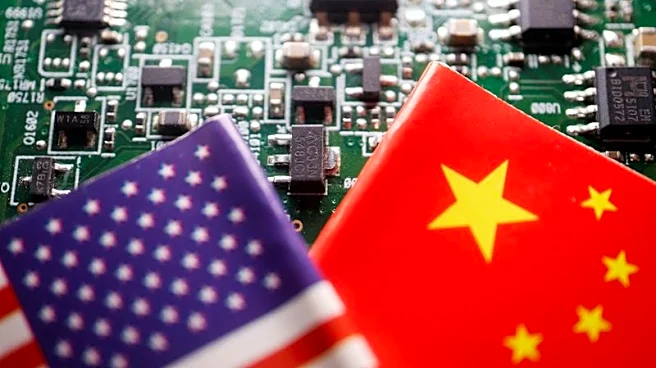
This development highlights the increasing impact of U.S. export controls on global technology supply chains, particularly concerning advanced computing hardware like Nvidia GPUs. The U.S. government's focus on restricting access to high-performance computing for Chinese entities, even those operating internationally, underscores national security and technological competition concerns. For Nscale, the potential inability to secure a license could significantly impact its revenue, given ByteDance's substantial contribution to its sales. This situation also creates uncertainty for other data center providers and their clients, particularly those with ties to China, as they navigate evolving regulatory landscapes. The broader implication is a potential fragmentation of the global technology ecosystem, where geopolitical considerations increasingly dictate access to critical infrastructure and components, affecting innovation and operational strategies for companies worldwide.
What's Next?
Nscale has not yet publicly stated whether it will apply for the required U.S. license. The company has a 90-day period from November 19 to secure this license to continue its services to ByteDance. The outcome of this decision and the U.S. Commerce Department's response will be closely watched by the technology industry. If Nscale fails to obtain the license, it would be forced to cease providing GPU access to ByteDance, potentially leading to a significant revenue loss for Nscale and operational challenges for ByteDance's AI and data processing needs. This situation could also prompt other data center operators and their clients to re-evaluate their supply chains and customer relationships in anticipation of similar regulatory actions. The decision will set a precedent for how U.S. export controls are enforced on international data center operations involving Chinese companies.
Beyond the Headlines
The requirement for Nscale to obtain a U.S. license for providing GPUs to ByteDance extends beyond a simple business transaction; it reflects a broader geopolitical strategy by the U.S. to control the flow of advanced technology to China. This move is part of an ongoing effort to limit China's advancements in artificial intelligence and other critical technologies, which are seen as having dual-use potential for both civilian and military applications. The ethical dimension arises from the extraterritorial application of U.S. laws, impacting companies operating in other sovereign nations like Norway and Iceland. Legally, it tests the boundaries of international trade regulations and national security prerogatives. Culturally, it could deepen the technological divide between the U.S. and China, potentially leading to the development of parallel technology ecosystems and further decoupling of global tech industries. This trend could reshape international collaborations and investments in the tech sector for years to come.