





What's Happening?
PIP Innovations has launched S-Blade, a specialized system designed for the precise removal of defects from French fries. This new technology utilizes machine vision, deep learning, and high-speed cutting to identify and eliminate defective sections of fries while
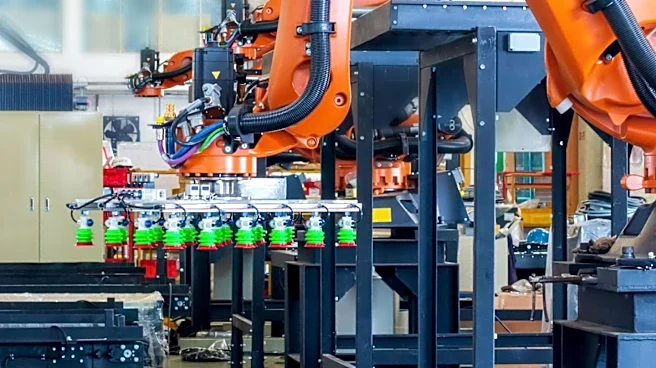
preserving the usable product. The S-Blade system evolved from PIP's earlier D-Blade platform, but was specifically developed to meet the high-throughput demands of modern French fry production, capable of processing up to 20 metric tons per hour. Unlike conventional vision systems that rely on fixed thresholds, S-Blade employs deep learning, trained with extensive imagery, to accurately distinguish between actual defects and normal variations in potato appearance. This allows the system to adapt to inconsistencies in raw materials, storage, and processing conditions without constant manual adjustments. The system features 48 lanes with high-speed servo blades that cut out only the defective portions, rather than rejecting entire fries, thereby maximizing product yield.
Why It's Important?
The introduction of PIP Innovations' S-Blade system is significant for the U.S. food processing industry, particularly for companies involved in French fry production. By precisely removing defects, the technology can lead to substantial reductions in product waste, directly impacting operational costs and profitability for processors. The ability to handle varying raw material conditions without continuous retuning means increased efficiency and consistency in product quality, which is crucial in a competitive market. For consumers, this could translate to a more consistent and higher-quality French fry product. Furthermore, the system's focus on removing only defective parts, rather than entire fries, aligns with broader sustainability goals by minimizing food waste. This innovation could set a new standard for quality control in the potato processing sector, potentially influencing investment in similar advanced technologies across the food industry to improve efficiency and reduce waste.
What's Next?
PIP Innovations views S-Blade as an evolving technology, with plans to continuously improve its software based on recurring cutting errors identified in operation. The company intends to distribute these software updates across installed machines, ensuring ongoing performance enhancements. Beyond defect detection, PIP is exploring additional applications for the machine's cameras and data, such as developing a cleanliness indicator to monitor machine condition. In the long term, the company envisions equipment capable of identifying potential problems, predicting maintenance needs, and autonomously adjusting operating parameters. There are also ongoing investigations into inspecting more sides of the French fry to detect additional types of defects. These future developments suggest a trend towards increasingly intelligent and self-optimizing food processing machinery, which could further revolutionize efficiency and quality control in the industry.
Beyond the Headlines
The S-Blade system represents a broader trend in industrial automation towards integrating complex software, such as deep learning, with relatively simple mechanical designs. This approach aims to reduce reliance on constant human intervention and make machinery more robust and cost-effective to operate. The ethical implications of such advanced automation include potential shifts in labor requirements within food processing plants, as tasks previously performed by human operators become automated. Culturally, the pursuit of 'perfect' food products, facilitated by technologies like S-Blade, reflects consumer expectations for consistent quality and appearance. This technological advancement also highlights the increasing sophistication of supply chain management, where every effort is made to maximize yield and minimize waste, driven by both economic incentives and growing environmental consciousness. The long-term shift could see more industries adopting similar AI-driven defect removal systems, pushing the boundaries of product quality and operational efficiency.