

What's Happening?
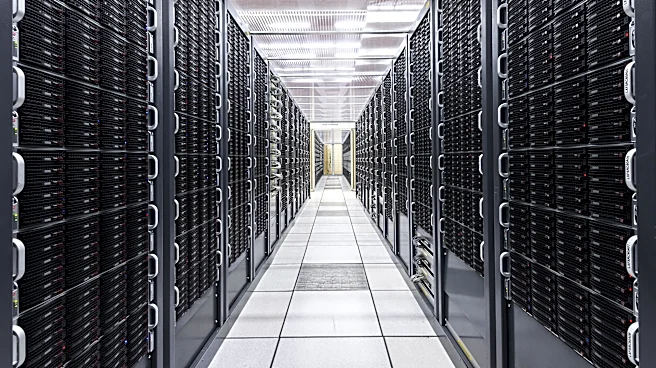
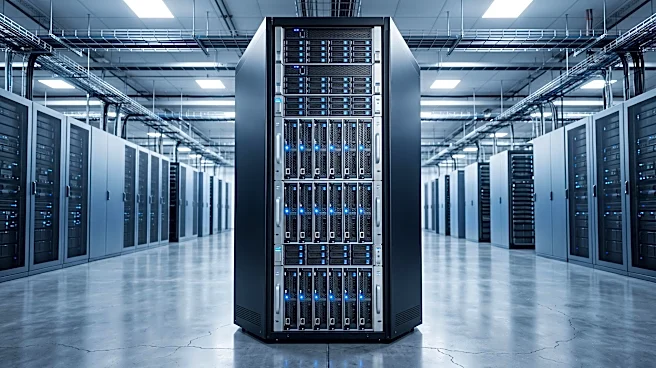
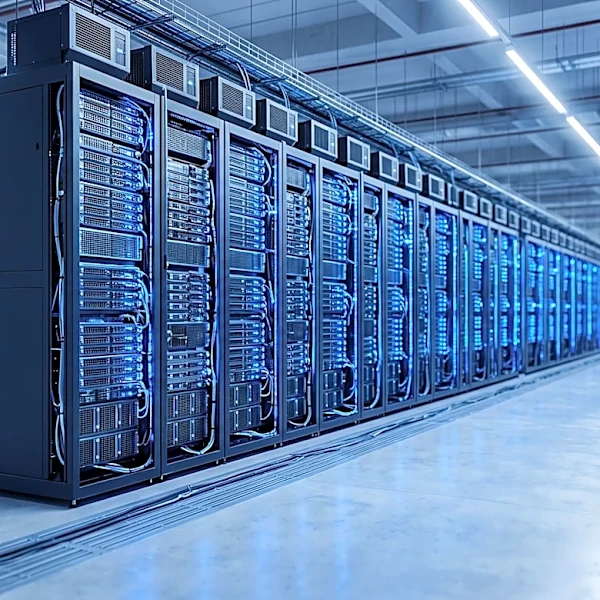
KIOXIA America, Inc. and Dell Technologies have collaborated to achieve a new storage-density milestone, creating the world's first 157 petabyte (PB) object storage solution in a single industry-standard 42U server rack. This solution is designed to support
modern AI and data lake workloads. It utilizes KIOXIA's 245.76 terabyte (TB) LC9 Series SSDs, with 640 of these SSDs configured within the rack. The system runs Dell ObjectScale, a software-defined, enterprise-grade, cloud-scale object storage platform, on 16 PowerEdge R7725xd servers. This innovative approach aims to improve data center efficiency by offering a smaller storage footprint, higher TB/W, and reduced cooling requirements compared to traditional HDDs or lower-capacity SSDs.
Why It's Important?
This collaboration between KIOXIA and Dell is highly significant for U.S. industries, particularly those heavily reliant on AI and large-scale data processing. The ability to store 157 PB of data in a single rack dramatically increases data center efficiency, reducing the physical space, power consumption, and cooling needed for massive data sets. This is crucial for companies engaged in generative AI, big data analytics, and other data-intensive applications, as it lowers operational costs and environmental impact. For U.S. businesses, this means faster data access, improved AI model training, and enhanced capabilities for managing unstructured data, providing a competitive edge in the global digital economy. The advancement also supports the broader trend towards more sustainable and efficient data center operations across the nation.
What's Next?
The development of high-density storage solutions like the 157 PB object store by KIOXIA and Dell is expected to drive further innovation in data center infrastructure. Future developments will likely focus on even higher capacity SSDs, more efficient power management, and advanced software-defined storage solutions tailored for AI and machine learning. This technology will enable U.S. companies to scale their AI initiatives more effectively, leading to breakthroughs in various sectors, from healthcare to finance. The adoption of such solutions will also influence data center design and construction, with a greater emphasis on density and energy efficiency. Dell and KIOXIA will likely continue to refine and expand this technology, offering even more robust and scalable options for enterprise clients.
Beyond the Headlines
The shift towards ultra-high-density flash storage for AI workloads represents a fundamental change in how data is managed and utilized. This move away from traditional hard disk drives (HDDs) to solid-state drives (SSDs) for large-scale data lakes and AI applications has broader implications for the entire digital ecosystem. It underscores the increasing demand for speed and efficiency in data processing, driven by the exponential growth of AI. This technological evolution could also lead to a re-evaluation of data governance and security strategies, as massive amounts of sensitive data are consolidated into smaller physical footprints. Furthermore, the environmental benefits of reduced power consumption and cooling requirements align with global sustainability goals, positioning U.S. tech companies at the forefront of green computing initiatives. This innovation is not just about storage; it's about enabling the next generation of AI-driven capabilities.