









What's Happening?
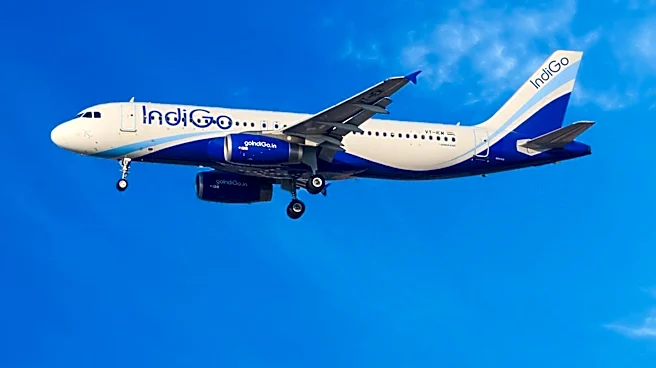
IndiGo, a major airline, is actively seeking deeper commercial partnerships with other airlines to facilitate its long-haul expansion and gain access to overseas markets. This strategy focuses on market access rather than financial investment. IndiGo’s
Chief Executive Officer Willie Walsh stated at the Aviation India and South Asia 2026 summit that these partnerships will be a crucial element of the airline's planned wide-body operations. The airline aims to leverage its extensive Indian network to attract overseas airlines, creating mutually beneficial relationships. IndiGo currently has over 10 codeshare partners, providing a foundation for these deeper collaborations. The airline is also preparing to introduce Airbus A350 aircraft in the second quarter of 2028, with preparations well underway.
Why It's Important?
This strategic move by IndiGo signifies a shift in how airlines approach international growth, prioritizing commercial cooperation over direct financial investment. For the U.S. aviation industry, this could mean increased competition or new partnership opportunities with a rapidly expanding Indian carrier. Deeper commercial relationships, such as codeshare agreements, joint businesses, and revenue-sharing arrangements, could lead to more diverse flight options and potentially lower fares for travelers between the U.S. and India. U.S. airlines might find IndiGo's extensive domestic network in India an attractive proposition for expanding their reach into the Indian subcontinent. Conversely, increased connectivity could also draw more international travelers through India, impacting existing global aviation hubs.
What's Next?
IndiGo will continue to explore various commercial models for partnerships, ranging from codeshare agreements to joint businesses and revenue-sharing arrangements. While no new agreements or specific partners have been announced, the airline's ambition to expand internationally and its domestic connectivity will likely drive future collaborations. The introduction of Airbus A350 aircraft in 2028 will be a significant milestone, enabling IndiGo to further its long-haul ambitions. Additionally, the airline expects its Airbus A321XLR aircraft to complement the A350 fleet in international markets, with cargo operations also playing a significant role in its future long-haul strategy. Elevated fuel prices and other near-term challenges are not expected to deter the airline from its long-term strategy.
Beyond the Headlines
IndiGo's strategy highlights a broader trend in the global aviation industry where airlines are increasingly forming alliances and partnerships to navigate competitive landscapes and expand into new markets without the significant capital outlay of direct investment. This approach allows for greater flexibility and risk-sharing. The focus on market access rather than financial investment could set a precedent for other airlines looking to grow their international footprint. Furthermore, the emphasis on India as a hub for international travel, connecting various overseas destinations through the country, could reshape global air travel patterns and increase India's strategic importance in the aviation sector. This could also lead to a re-evaluation of existing airline alliance structures.