






What's Happening?
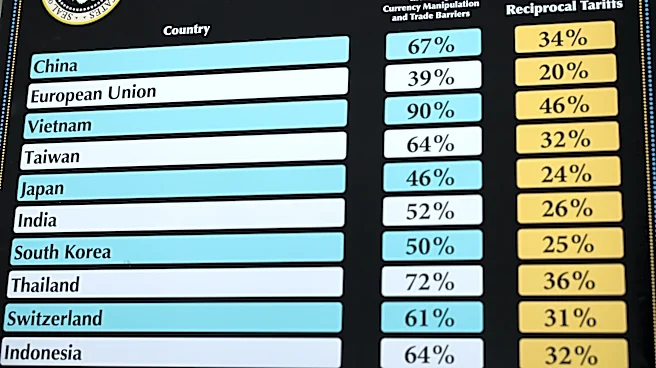
Consumer goods companies are actively reconfiguring their supply chains in response to increasing trade volatility and rising global tariffs, particularly in the U.S. The Thomson Reuters Institute's 2026 Global Trade Report indicates that 72% of trade professionals
identify U.S. tariff volatility as the most impactful regulatory change for their organizations. This trend, reinforced by rising trade-weighted global tariffs in 2025, has hit the manufacturing sector significantly. A survey of U.S. importers revealed that 79% moved at least a portion of their sourcing away from China in 2025 to adapt to changing cost structures and trade risks. Companies are now prioritizing resilience, flexibility, and customer responsiveness over pure efficiency in their supply chain strategies.
Why It's Important?
The shift in supply chain strategies by consumer goods companies has profound implications for the U.S. economy and global trade. By diversifying sourcing networks and expanding regional manufacturing capabilities, these companies aim to mitigate risks associated with geopolitical tensions and tariff uncertainty. This move away from concentrated production in single locations enhances supply chain resilience, ensuring continuity and protecting profit margins in an unpredictable economic environment. For middle-market consumer goods organizations, proactive evaluation of their supply chain footprints is becoming a competitive differentiator, allowing them to better respond to ongoing economic and geopolitical uncertainties and maintain market stability.
What's Next?
The trend of supply chain regionalization and diversification is expected to continue, with companies investing in more agile and responsive operational models. This will involve careful consideration of tax implications and trade policies in their planning processes to reduce avoidable costs and support long-term growth. Consumer expectations for faster fulfillment, greater product availability, and transparency in sourcing will further drive these changes, pushing companies to establish shorter supply chains. Capital investment and strategic planning will be crucial for organizations evaluating regionalization opportunities, including assessing supplier concentration risks, alternative sourcing strategies, and manufacturing network design. Scenario planning for future disruptions, such as changes in tariffs and geopolitical developments, will become standard practice.
Beyond the Headlines
Beyond the immediate economic and logistical adjustments, the reconfiguration of supply chains signifies a broader re-evaluation of globalization. While not a complete retreat from global trade, it represents a strategic pivot towards balancing efficiency with resilience. This shift could lead to a more fragmented global manufacturing landscape, with increased regional trade blocs and localized production. The emphasis on ethical sourcing and sustainable operating models, driven by rising consumer expectations, also suggests a deeper cultural and social impact on how goods are produced and distributed. This evolution could reshape international economic relationships and foster greater self-sufficiency within regions, potentially altering the dynamics of global competition and cooperation.