



What's Happening?
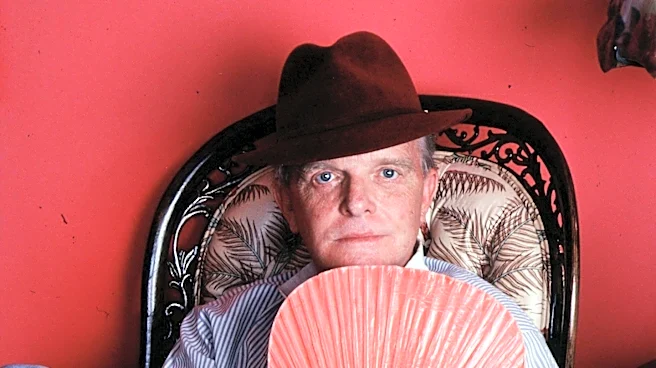
Vogue recently published an archival feature showcasing Truman Capote's seaside studio, as it appeared in the November 1965 issue of the magazine. The article, titled 'Flashback to 1965: Truman Capote and the Seaside Studio He Designed for Work,' includes
photographs by Horst P. Horst. Capote designed this studio specifically for his work, where he completed the galleys for his book, 'In Cold Blood.' The piece highlights Capote's distinct approach to separating his work life from his social life, emphasizing his focused hours in a 'narrow, monastic office' within his plain, grey-brown wooden house on Long Island. The house, situated a few hundred yards from the ocean between wheat and potato fields, is described as straightforward American, amusing, and polished, reflecting Capote's charm and personality.
Why It's Important?
This retrospective offers a glimpse into the private working environment of a significant American literary figure, Truman Capote, at a pivotal moment in his career, just as 'In Cold Blood' was being finalized. For literary enthusiasts and cultural historians, it provides valuable context on the creative process and personal habits of an author whose work profoundly impacted American literature. For the fashion and design industries, Vogue's decision to revisit this historical feature underscores the enduring appeal of classic design and the intersection of personal style with living and working spaces. It also highlights how publications like Vogue contribute to preserving and re-contextualizing cultural history, influencing contemporary aesthetics and lifestyle trends by drawing from past icons.
Beyond the Headlines
The feature subtly explores the concept of intentional design for productivity and personal sanctuary. Capote's deliberate creation of a 'monastic office' devoid of distractions speaks to a timeless need for focused environments, a concept increasingly relevant in today's hyper-connected world. This archival piece from Vogue not only celebrates Capote's aesthetic choices but also implicitly comments on the psychological benefits of a dedicated workspace, suggesting that environment plays a crucial role in creative output. It also reinforces Vogue's role beyond just fashion, positioning it as a chronicler of broader cultural and lifestyle narratives that resonate across generations.