


What's Happening?
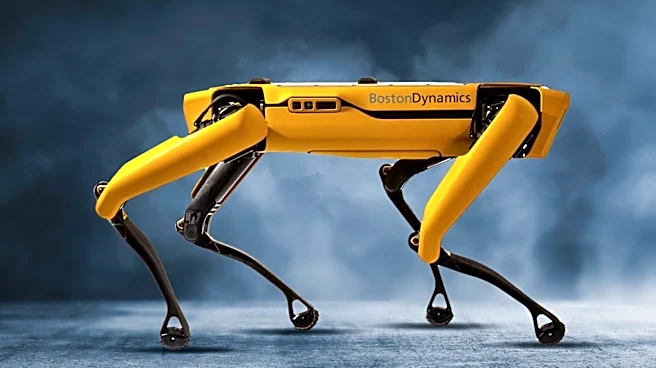
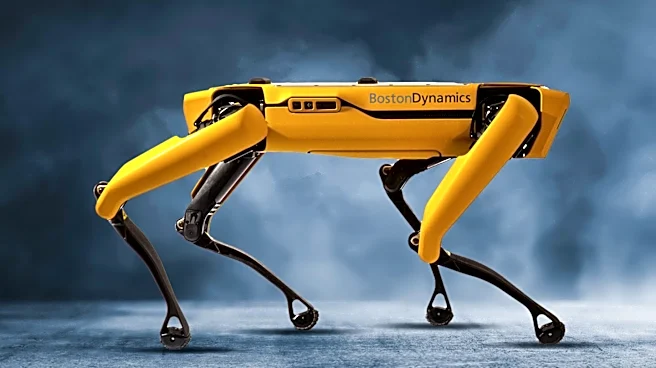
Clobot, a South Korean robot service and solutions company, anticipates its revenue from the business involving Boston Dynamics' quadruped robot, 'Spot,' to surpass 10 billion won (approximately $7.4 million) this year. This marks the company's highest
performance on record for its Spot-related operations. Clobot, a sales distributor and systems integration (SI) partner for Boston Dynamics, recently unveiled a live demo room at its headquarters in Seongnam, Gyeonggi Province. The company plans to broaden the application of its industrial quadruped robot business, extending beyond facility inspection to include power plants and public safety sectors. In 2024, Clobot became the first among Boston Dynamics' global partners to receive SI certification, which has been confirmed for renewal next year. Over the past four years, including the business period of its subsidiary Roas, Clobot has supplied more than 90 Spot units and completed over 140 projects. Spot robots, equipped with advanced sensors like thermal imaging cameras, acoustic imaging sensors, and lidar, are used to detect equipment overheating, gas leaks, and abnormal noise. Clobot integrates its own solutions with Boston Dynamics' 'Orbit' monitoring software and utilizes Google's robotics AI, 'AIVI,' for video inspection and report generation.
Why It's Important?
This development highlights the increasing industrial adoption of advanced robotics, particularly Boston Dynamics' Spot, for critical tasks in various sectors. Clobot's record revenue and expansion plans demonstrate a growing market demand for automated inspection, maintenance, and safety solutions, even for high-cost robotic systems. The integration of Clobot's proprietary solutions with Boston Dynamics' technology, along with Google's robotics AI, signifies a trend towards more sophisticated and integrated robotic ecosystems. This partnership and the successful deployment of Spot in diverse environments, from steel mills and smelters to power plants and airports, underscore the robot's versatility and effectiveness in hazardous or complex industrial settings. The expansion into public safety, such as supporting emergency responses in Sejong City, indicates a broader societal impact, potentially enhancing safety and efficiency in critical infrastructure management. The success of Clobot as an SI partner also emphasizes the importance of specialized integrators in customizing and deploying advanced robotic solutions to meet specific industry needs.
What's Next?
Clobot intends to further expand the scope of its industrial quadruped robot business, moving into new areas such as power plants and public safety. The company's continued SI certification with Boston Dynamics suggests a sustained partnership and ongoing development of integrated solutions. With an expected sales volume of approximately 30 Spot units this year, Clobot is poised for continued growth in the robotics market. The company's focus on combining its solutions with Boston Dynamics' monitoring software and Google's robotics AI indicates a future direction towards more intelligent and autonomous robotic operations. As demand for automated inspection and safety solutions grows, Clobot will likely continue to secure more projects and expand its customer base, which currently includes major entities like POSCO, Korea Zinc, Korea Western Power, Sejong City, Incheon International Airport Corporation, and Hyundai Motor. The ongoing development of AI-powered inspection functions will further refine the robots' capabilities, potentially leading to even more precise and efficient anomaly detection and reporting.
Beyond the Headlines
The successful deployment of Boston Dynamics' Spot robots by Clobot in South Korea points to a broader global trend of increasing automation in industries that involve dangerous or repetitive tasks. The high price point of the Spot robot, comparable to a luxury vehicle, suggests that the return on investment for such advanced robotics is significant, driven by enhanced safety, efficiency, and data accuracy. The use of AI for analyzing visual and sensor data, as seen with Google's AIVI, highlights the critical role of artificial intelligence in making these robotic systems truly intelligent and actionable. This integration of hardware and AI software is transforming how industries approach facility management, predictive maintenance, and emergency response. Furthermore, the expansion into public safety applications, such as monitoring bridges and verifying suspicious objects at airports, raises important discussions about the ethical implications and societal acceptance of autonomous robots in public spaces. The long-term impact could include a significant reduction in human exposure to hazardous environments and a redefinition of roles for human workers in industrial and public safety sectors.