







What's Happening?
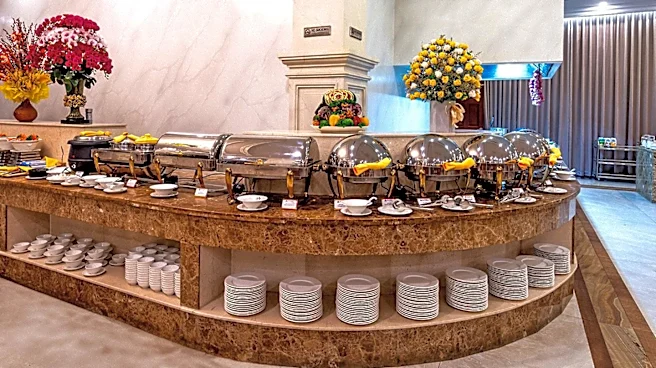
Good Time Country Buffet, a new restaurant concept by David Yun, Steve Choi, and Yong Min Kim, is set to open in New York City's East Village in mid-September after initial delays. The establishment aims to bring an authentic Southern country buffet experience
to Manhattan, featuring an all-you-can-eat model with a fixed price. The owners, who are Korean Americans raised in Atlanta, are drawing on their teenage experiences with Southern buffets. The menu will include classic dishes such as double-fried chicken, rib tips, collard greens, and mac and cheese, with rotating daily specials like meatloaf, fried shrimp, and country ham. The pricing is set at $26.99 for adults and $13.99 for children, with a 10% discount for seniors, emphasizing affordability in the New York dining scene. The interior design is intentionally reminiscent of traditional country buffets, featuring carpeted floors and multiple wallpaper patterns to evoke a sense of nostalgia and authenticity.
Why It's Important?
The opening of Good Time Country Buffet is significant for the New York City restaurant landscape, particularly in the East Village, as it introduces an affordable, all-you-can-eat dining option that is increasingly rare in the city. This venture challenges the prevailing trend of high-priced, specialized dining experiences by focusing on value and volume. For consumers, it offers a budget-friendly alternative for family dining or group meals, potentially attracting a diverse clientele seeking comfort food without a hefty price tag. From an economic perspective, the profitability of such a model in a high-rent urban environment like Manhattan will be a key indicator for future similar ventures. The owners' decision to prioritize affordability, even admitting they 'could charge more,' highlights a commitment to accessibility that could resonate with a broader demographic and potentially influence other restaurateurs to consider more value-oriented concepts. The success of this model could demonstrate the viability of high-volume, lower-margin dining in competitive urban markets.
What's Next?
Following its mid-September opening, Good Time Country Buffet will need to demonstrate the sustainability of its all-you-can-eat model in the East Village. The owners anticipate a maximum dining time of 75 minutes per customer to ensure quick table turnover, which is crucial for profitability in a fixed-price, high-volume setting. The restaurant's ability to manage food costs, maintain quality, and attract a consistent flow of customers will be critical. Potential reactions from major stakeholders include local diners embracing the affordable option, while other restaurateurs might observe its performance to gauge the market for similar concepts. The restaurant's success could also influence real estate trends in the area, potentially encouraging more diverse and accessible dining options. The owners' confidence, stemming from their experience with other successful ventures like Kisa, suggests a strategic approach to operational efficiency and customer experience will be central to their next steps.
Beyond the Headlines
The Good Time Country Buffet project delves deeper into the cultural and social fabric of American dining, particularly through the lens of Korean American entrepreneurs. The owners' narrative of growing up in Atlanta and their connection to Southern country buffets highlights a unique cross-cultural experience, where immigrant communities often adopt and adapt local business models. This venture is not just about food; it's about nostalgia, identity, and the American dream of entrepreneurship. The choice to recreate an authentic country buffet, complete with specific interior design elements like carpeted floors and varied wallpapers, speaks to a desire to preserve and share a particular cultural memory. It also subtly challenges the notion of what constitutes a 'fine dining' experience in New York, suggesting that comfort, affordability, and a sense of community can be equally valuable. The economic model, relying on the balance between those who 'overdo' the buffet and those who 'underutilize' it, reflects a fascinating psychological aspect of consumer behavior in the food industry.