






What's Happening?
Stillstrom by Maersk has signed a Letter of Intent (LOI) with Semco Maritime for the manufacturing and delivery of a crucial component of its offshore vessel charging system. This agreement marks a significant step as the technology transitions from its design
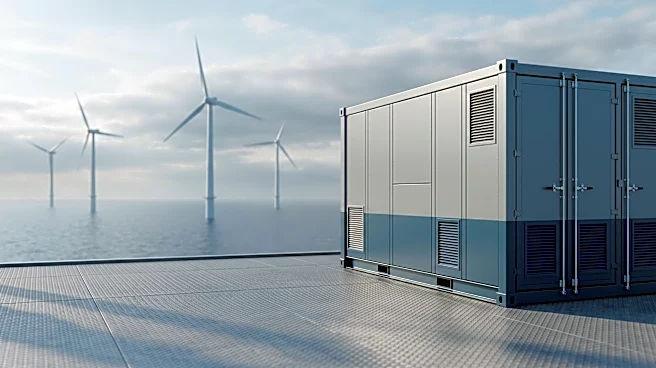
phase into manufacturing. Semco Maritime will be responsible for producing the Local Equipment Room (LER), which serves as the central control unit for power, communications, and safety functions within Stillstrom's offshore charging infrastructure. The LER is a containerized unit designed to house the transformer and medium-voltage switchgear, facilitating the transfer of electricity from offshore wind farms to vessels. It also incorporates communication equipment, ventilation, and fire safety systems. The manufacturing is slated to occur at Semco Maritime's facility in Esbjerg, Denmark, with completion anticipated by spring 2027. Future units may also be produced at Semco Maritime's UK facilities. Siemens will act as a subcontractor, supplying the switchgear and control systems, under a separate LOI signed with Semco Maritime.
Why It's Important?
This partnership is important for the advancement of sustainable maritime operations and the broader renewable energy sector. The development and deployment of offshore charging systems for fully electric and hybrid service operation vessels (SOVs) are critical for reducing the carbon footprint of the shipping industry, particularly in the context of offshore wind farm maintenance and operations. By enabling vessels to charge directly from offshore wind structures, the technology reduces reliance on fossil fuels, leading to lower emissions and operational costs. The LER, as the 'nerve center' of the charging system, is essential for ensuring the safe and efficient transfer of power. This initiative supports the global transition towards cleaner energy sources and infrastructure, demonstrating a tangible step in integrating renewable energy into maritime logistics. The collaboration between Stillstrom, Semco Maritime, and Siemens highlights the complex engineering and strategic partnerships required to achieve these environmental and technological goals.
What's Next?
The immediate next step is the manufacturing of the Local Equipment Room (LER) at Semco Maritime's facility in Esbjerg, Denmark, with a target completion date of spring 2027. Following this, the LERs will be integrated into Stillstrom's offshore charging infrastructure, which can be installed on monopiles or hang-off structures at charging locations. The successful deployment of these units will pave the way for the broader adoption of offshore charging solutions for electric and hybrid vessels. Stillstrom also indicated the potential for future manufacturing of units at Semco Maritime's UK facilities, suggesting a possible expansion of production capacity. The ongoing collaboration with Siemens for switchgear and control systems will be crucial for the technical functionality of the LERs. The long-term outlook involves the widespread implementation of this technology to support the growing fleet of electric and hybrid SOVs, further decarbonizing offshore operations and enhancing the efficiency of renewable energy infrastructure.
Beyond the Headlines
This development signifies a deeper shift in the energy transition, moving beyond just generation to focus on integration and infrastructure. The ability to efficiently charge vessels directly from offshore wind farms addresses a critical challenge in the operational sustainability of the maritime industry. It underscores the increasing interconnectedness of different sectors—renewable energy, maritime, and engineering—in achieving climate goals. The technology's success could set a precedent for other industries requiring mobile power solutions in remote or offshore environments. Furthermore, the emphasis on robust control and safety systems within the LER highlights the complex engineering and cybersecurity considerations inherent in advanced energy infrastructure. This move also reflects a broader trend of industrial players investing in and developing solutions that support the circular economy and reduce environmental impact, demonstrating a commitment to sustainable practices that extend beyond their core business operations.