
What's Happening?
U.S. banknotes featuring 'solid' serial numbers, which consist of a single repeating digit (e.g., '11111111' or '77777777'), are highly sought after by collectors and can fetch prices significantly above
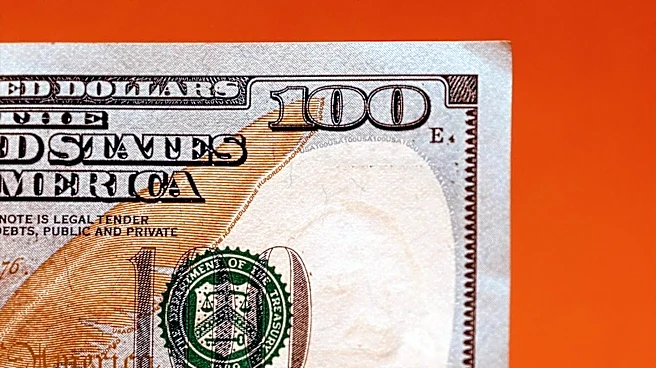
their face value. According to Doug Mudd, curator and director of the American Numismatics Association's Edward C. Rochette Money Museum, these notes are among the most recognized 'oddities' in paper-money collecting due to their noticeable nature. While mathematically no rarer than other serial numbers, their distinct appearance makes them popular. Auction data from Heritage Auctions and Stacks Bowers shows that solid-numbered bills, especially those in good condition or with culturally significant numbers like '77777777' or '88888888', have sold for thousands of dollars. For instance, a 'near-perfect' $100 bill with a solid '8' serial number sold for over $19,000 in 2024. Even imperfect notes with solid serial numbers can command many times their face value, with recent eBay sales showing an ungraded $1 note with a solid '3' selling for $1,600 and a $5 bill with a solid '2' selling for $2,660.
Why It's Important?
The significant value placed on banknotes with 'solid' serial numbers highlights a niche but lucrative aspect of the U.S. collectibles market. This phenomenon demonstrates how unique characteristics, even those with no inherent functional difference, can create substantial demand and financial value within specialized communities. For the average American, it means that a seemingly ordinary dollar bill could potentially be worth thousands, encouraging a closer look at currency. This market also supports a network of dealers, auction houses, and collectors, contributing to a sub-economy centered around numismatics. The appeal of these 'fancy' serial numbers, particularly 'solid' ones, underscores the psychological and cultural factors that drive collecting, where rarity and aesthetic uniqueness often translate into monetary worth, even if the mathematical rarity is the same as any other serial number.
What's Next?
The market for 'fancy' serial number banknotes is expected to continue thriving, driven by dedicated collectors willing to pay premiums for unique specimens. Individuals who come across U.S. banknotes should inspect their serial numbers for 'solid' patterns, as well as other 'fancy' numbers like 'radar' (palindromic) serials, as these could hold significant value. Numismatic experts and auction houses will likely continue to facilitate the trade of these notes, with prices fluctuating based on condition, specific serial number, and market demand. Educational efforts by organizations like the American Numismatics Association may also increase public awareness of these valuable currency oddities, potentially leading to more discoveries and entries into the collector market.
Beyond the Headlines
Beyond their monetary value, the fascination with 'solid' serial number banknotes reflects a broader human inclination towards pattern recognition and the appreciation of unique, aesthetically pleasing anomalies. In a world of mass-produced items, even something as ubiquitous as currency can become an object of specialized interest and value when it deviates from the norm in a visually striking way. This collecting trend also touches upon cultural beliefs, as certain numbers (like '7' or '8') are considered lucky or auspicious in various cultures, further enhancing their appeal and value. The existence of such a market for 'fancy' serial numbers challenges the conventional understanding of currency as merely a medium of exchange, revealing its potential as an artifact with intrinsic collectible worth, driven by human perception and desire for uniqueness rather than just utility.