







What's Happening?
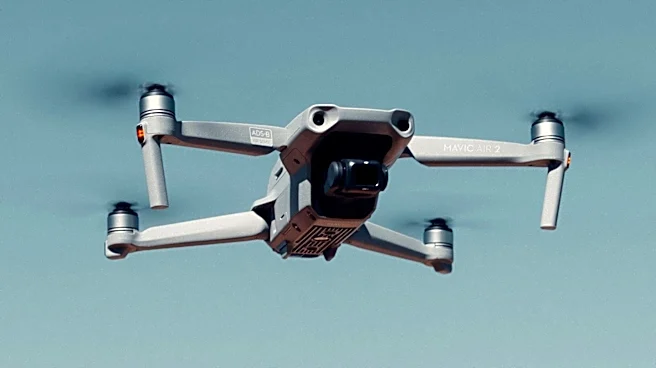
Ericsson has announced plans to begin commercial pilots in 2027 for its new Integrated Sensing and Communication (ISAC) System, which aims to transform ordinary mobile networks into drone detection sensor grids. This technology utilizes the radio signals
that bounce off flying objects, allowing existing cell sites to detect, locate, and track drones. The initial pilots will focus on sensing-only capabilities, with broader deployments expected from 2028. Ericsson has conducted field demonstrations with partners, including AT&T in Arlington, Texas, where the system successfully detected and tracked multiple drones. The company positions ISAC as a complementary layer to existing drone detection tools like radar, RF scanners, and acoustic sensors, offering wide-area coverage by reusing existing network infrastructure.
Why It's Important?
This development is significant for U.S. industries and public safety, as it offers a potentially cost-effective and scalable solution to the growing challenge of drone proliferation. With commercial drone operations expanding rapidly and unauthorized drone sightings becoming a concern for critical infrastructure, airports, and public venues, a wide-area detection system is crucial. By leveraging existing 5G networks, the ISAC system could provide enhanced security without the need for extensive new sensor installations. This could benefit sectors such as defense, public safety, and critical infrastructure operators by enabling better monitoring of airspace and early detection of potential threats. The ability to detect drones not connected to the network is a key advantage, addressing a significant security gap.
What's Next?
Ericsson plans to initiate small-scale, sensing-only commercial pilots with selected customers in 2027, followed by broader deployments from 2028. While specific pilot customers have not been named, the AT&T trial in Arlington, Texas, suggests potential U.S. involvement. The company will need to provide more concrete data on detection range, accuracy, and pricing to attract widespread adoption. The technology's evolution towards 6G will see the integration of communication components, expanding its capabilities beyond just sensing. Regulatory frameworks and privacy concerns regarding airspace data collection will also need to be addressed as the system scales. The success of these pilots will determine the pace of adoption and the extent to which mobile networks become integral to national airspace security.
Beyond the Headlines
The Ericsson ISAC system represents a fundamental shift in how cellular networks are perceived and utilized, moving beyond mere communication to integrated sensing capabilities. This convergence of communication and sensing could have profound long-term implications for urban planning, smart cities, and national security. It raises ethical questions about pervasive surveillance and data privacy, as mobile networks could potentially monitor all flying objects, not just drones. The development also highlights the increasing importance of Massive MIMO 5G radio platforms and edge computing, driving further innovation in these areas. This technology could also pave the way for more sophisticated drone traffic management systems, enabling safer integration of drones into civilian airspace while simultaneously enhancing security against malicious use.