









What's Happening?
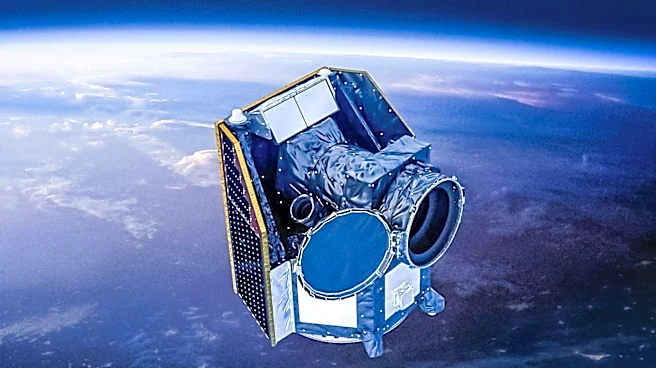
City Labs, a Miami-based company, has launched a satellite named BOHR, marking a significant milestone in the use of nuclear power in space. The satellite, which is part of a SpaceX rideshare mission, is described as the world's first commercial nuclear-powered
satellite and the first nuclear CubeSat. BOHR is equipped with a nuclear betavoltaic battery that generates electricity from the decay of tritium, a radioactive isotope of hydrogen. This technology allows for continuous power supply, independent of sunlight or battery life, making it ideal for long-duration missions. The satellite was released into an orbit between 350 and 400 miles above Earth. City Labs aims to demonstrate the viability of its NanoTritium power generator, which could have applications in remote sensors and medical devices.
Why It's Important?
The launch of BOHR represents a pivotal advancement in space technology, particularly in the realm of power generation. By utilizing nuclear power, City Labs is addressing the challenge of providing a reliable energy source for space missions that are not dependent on solar power. This development could significantly enhance the capabilities of satellites and other space technologies, enabling longer missions and more robust operations. The success of this mission could lead to broader adoption of nuclear power in space, potentially supporting future endeavors such as permanent lunar bases or deep space exploration. The implications extend beyond space, as the technology could also be applied to terrestrial uses, such as powering remote sensors and medical devices, offering a new avenue for innovation in these fields.
What's Next?
Following the successful launch of BOHR, City Labs is likely to focus on further testing and validation of its NanoTritium power generator in space. The company may explore additional partnerships and collaborations to expand the use of its technology in other space missions. Regulatory approval and safety assessments will continue to be crucial as the company seeks to scale its operations. The broader space industry will be watching closely to see how this technology performs, which could influence future investments and developments in nuclear-powered space technologies. Additionally, the success of this mission may prompt other companies to explore similar technologies, potentially leading to a new era of innovation in space exploration.