









What's Happening?
The Fédération Internationale de Volleyball (FIVB) has published its official rules for the 2025–2028 period, outlining precise specifications for volleyball courts and equipment. According to the FIVB Official Volleyball Rules 2025–2028, a standard volleyball court measures
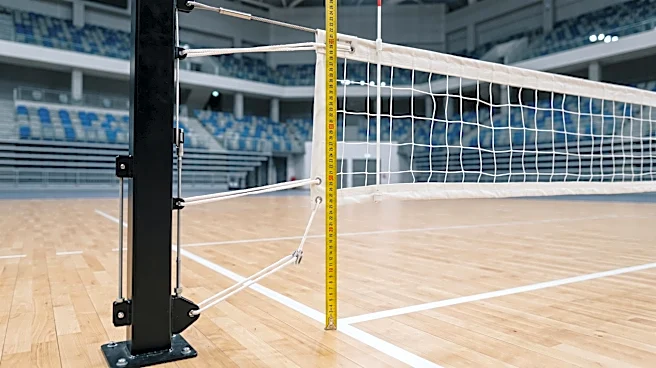
18 meters long and 9 meters wide. It must be surrounded by a free zone of at least 3 meters on all sides, with a minimum obstacle-free height of 7 meters above the floor. For men's competitions, the net height is set at 2.43 meters, while for women's competitions, it is 2.24 meters. The rules also specify enhanced requirements for FIVB world and official competitions, where the free zone extends to 5 meters beside the sidelines and 6.5 meters behind the end lines, and the clear height increases to 12.5 meters. These detailed regulations ensure uniformity and fairness across all levels of professional volleyball.
Why It's Important?
These updated FIVB rules are crucial for maintaining consistency and integrity in volleyball competitions globally, including those held in the U.S. Adherence to these standards impacts facility design, player training, and competitive play. For U.S. sports organizations, universities, and professional leagues, understanding and implementing these specifications is essential for hosting sanctioned events and ensuring their athletes compete under official conditions. The precise measurements for court dimensions, net heights, and free zones directly influence game strategy and player performance. Furthermore, the distinction between general minimums and requirements for FIVB world competitions highlights the escalating demands for elite-level venues, potentially driving investment in upgraded sports infrastructure across the U.S. This standardization also helps in the development of young athletes, as they train on courts that meet international benchmarks, preparing them for higher levels of competition.
What's Next?
U.S. volleyball organizations, including collegiate athletic programs and professional leagues, will need to review and implement these updated FIVB rules to ensure compliance. This may involve adjustments to existing facilities or the design of new ones, particularly for those aspiring to host international events. Coaches and players will continue to adapt their training and strategies to these standardized conditions. The rules also provide a framework for officials and referees to ensure fair play and consistent application of regulations during matches. Future discussions may focus on how these rules impact the growth of volleyball at the grassroots level and the potential for further adaptations to accommodate different age groups or developmental stages within the sport.
Beyond the Headlines
The meticulous detailing of volleyball court specifications by the FIVB reflects a broader trend in professional sports towards hyper-standardization. This not only ensures competitive fairness but also influences the global market for sports equipment and facility construction. For the U.S., this means that manufacturers of volleyball nets, court flooring, and lighting systems must meet these precise international standards, fostering innovation and quality control within the industry. Moreover, the emphasis on clear height and free zones underscores player safety and the dynamic nature of modern volleyball, where powerful serves and attacks require ample space. The rules also subtly shape the aesthetic and functional aspects of sports arenas, contributing to a consistent spectator experience worldwide.