







What's Happening?
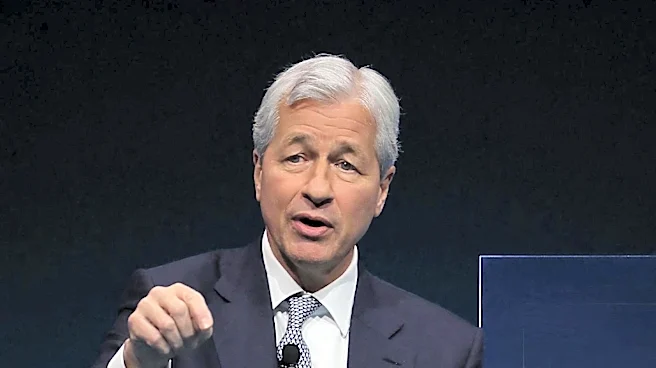
Jamie Dimon, CEO of JPMorgan Chase & Co., has outlined a comprehensive plan to revitalize the U.S.-Europe trade relationship and strengthen alliances with Western nations. In a Wall Street Journal op-ed, Dimon advocated for a 'big, beautiful economic
and free-trade agreement' with Europe. This proposal is contingent on Europe undertaking significant economic and military reforms. Dimon suggests that such an agreement could also extend to other democratic countries, including Canada, Mexico, Japan, South Korea, Australia, and the Philippines. He believes these trade connections would be an 'economic and geopolitical game changer' for the U.S. and its allies, enabling them to establish global trade rules and present a united front against autocratic pressures. Dimon emphasized that a more economically robust Europe would serve as a stronger security partner and a more effective counterweight to China's growing economic influence. He also stressed the importance of the U.S. maintaining its global leadership through military strength, economic dominance, and a renewed commitment to American values.
Why It's Important?
This proposal by a prominent U.S. financial leader carries significant implications for U.S. foreign policy, economic strategy, and global alliances. By advocating for a robust free trade agreement with Europe and other democratic nations, Dimon is pushing for a strategic realignment that could reshape global trade dynamics. The emphasis on Europe's economic and military reforms suggests a desire for a more balanced and capable partnership, which could alleviate some of the burden on the U.S. in international security and economic competition. If implemented, such a pact could create a powerful economic bloc, potentially setting new global standards for trade and investment. This move would directly challenge China's expanding economic influence and could lead to a more competitive international landscape. For U.S. industries, a 'big, beautiful' trade deal could open new markets and foster greater economic integration with key allies, potentially boosting economic growth and creating jobs. Conversely, industries that thrive on protectionist policies might face new challenges. The proposal also underscores a broader concern within U.S. leadership about maintaining global economic leadership and strengthening democratic alliances in an increasingly complex geopolitical environment.
What's Next?
The immediate next steps would likely involve discussions and negotiations between U.S. and European policymakers regarding the feasibility and scope of such a comprehensive trade agreement. Europe would need to seriously consider the proposed economic and military reforms, which could involve significant internal policy changes and political will. The U.S. administration, regardless of who is in power, would need to evaluate the political and economic benefits of pursuing such a large-scale free trade pact, especially given past protectionist sentiments. Reactions from other democratic nations mentioned, such as Japan, South Korea, and Australia, would also be crucial in determining the potential for a broader alliance. The proposal could spark debates within the U.S. Congress and among various industry groups about the potential impacts on domestic markets and employment. Furthermore, China's response to the formation of such a powerful economic bloc would be a key factor, potentially leading to increased geopolitical tensions or a re-evaluation of its own trade strategies. The success of this initiative hinges on strong political leadership and a shared vision among the participating nations to counter autocratic pressures and establish new global trade norms.
Beyond the Headlines
Dimon's proposal extends beyond mere trade agreements, touching upon the fundamental principles of global governance and the future of democratic alliances. By linking trade to military and economic reforms, he is implicitly suggesting a more integrated and interdependent Western bloc, where economic prosperity is directly tied to collective security and shared values. This approach could lead to a deeper philosophical debate about the role of free markets in promoting democracy and stability, especially in contrast to state-controlled economies. The emphasis on 'American values' and 'the American dream' highlights a desire to reassert U.S. moral and ideological leadership on the global stage, moving beyond purely transactional relationships. This could also trigger discussions about the long-term sustainability of current global supply chains and the need for greater resilience and diversification among allied nations. The proposal's success could redefine the geopolitical landscape for decades, potentially ushering in an era of renewed Western cooperation and a more robust challenge to authoritarian models. Conversely, failure to achieve such an agreement could further fragment the global order and embolden rival powers.