



What's Happening?
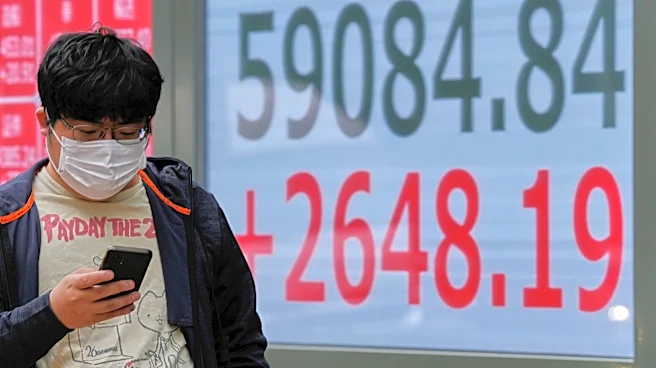
Tokyo Electron (TOELF) shares experienced a significant rise of 7.67%, closing at 8,946 yen in Tokyo's regular session on November 24. This surge contributed to a broader 3.91% Nikkei rally, primarily driven by chip-equipment manufacturers. The market's
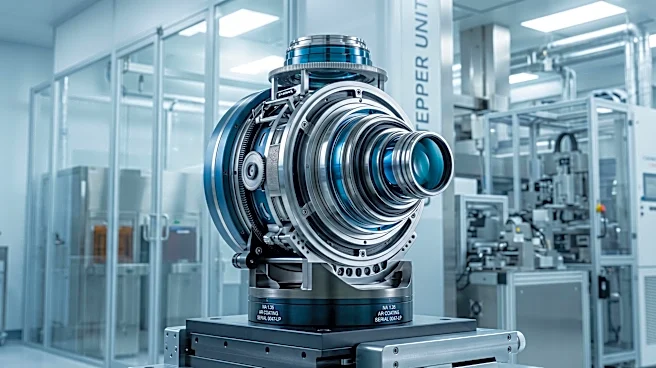
positive reaction followed Nvidia's reinstatement of Jensen Huang, with Tuesday being the first trading day for Tokyo to respond after a Monday closure. Tokyo Electron is a key supplier of essential tools, including etch, deposition, and coating equipment, which are crucial for chipmakers in the production of AI processors and memory components. The company has reported robust financial results for the first half of the fiscal year, ending September, with revenue reaching 1.667 trillion yen, marking a 41.3% increase. Operating profit also saw a substantial rise of 67.2% to 506.8 billion yen, expanding the operating margin to 30.4%.
Why It's Important?
The strong performance of Tokyo Electron and the broader chip-equipment sector underscores the increasing demand for advanced semiconductor manufacturing capabilities, particularly those related to artificial intelligence. As a critical supplier of tools for AI processors and memory, Tokyo Electron's growth reflects the ongoing expansion and investment within the global semiconductor industry. The company's impressive financial guidance for the fiscal year ending March 2027, projecting revenue of 3.7 trillion yen (up 51.4%) and operating profit of 1.169 trillion yen (up 87.1%), indicates sustained confidence in future market demand. This growth is vital for the technology sector, as it enables the production of more powerful and efficient chips that drive innovation across various industries, from consumer electronics to advanced computing. The rally also highlights investor optimism in the long-term prospects of companies integral to the AI revolution.
What's Next?
Tokyo Electron is forecasting continued strong growth, with projections for the fiscal year ending March 2027 including revenue of 3.7 trillion yen, operating profit of 1.169 trillion yen, and net income of 865 billion yen. Achieving these targets will require a significant step-up in revenue during the second half of the current fiscal year, with approximately 2.03 trillion yen needed. The company's next significant financial update will be its third-quarter results in early 2027, which will be closely watched by investors, particularly for insights into spending trends by memory makers. The current valuation, with net income forecasts implying roughly 22 times earnings against an 18.81 trillion yen market value, suggests that much of the recent stock rebound reflects a recovery to fair value. Future performance will depend on sustained demand for chip manufacturing tools and the company's ability to meet its ambitious financial guidance.
Beyond the Headlines
The robust performance of Tokyo Electron and the broader chip-tool industry points to a deeper trend of increasing global reliance on advanced semiconductor technology. The demand for AI processors and high-capacity memory is not merely a cyclical upswing but a fundamental shift driven by the pervasive integration of artificial intelligence across industries. This sustained demand could lead to further innovation in chip manufacturing processes, potentially pushing the boundaries of what is currently possible in terms of chip density and performance. Furthermore, the strategic importance of companies like Tokyo Electron in the global supply chain for critical technologies could have geopolitical implications, as nations increasingly prioritize domestic semiconductor capabilities. The ongoing investment in this sector also suggests a long-term commitment to technological advancement, which will likely fuel economic growth and transform various aspects of daily life.