


What's Happening?
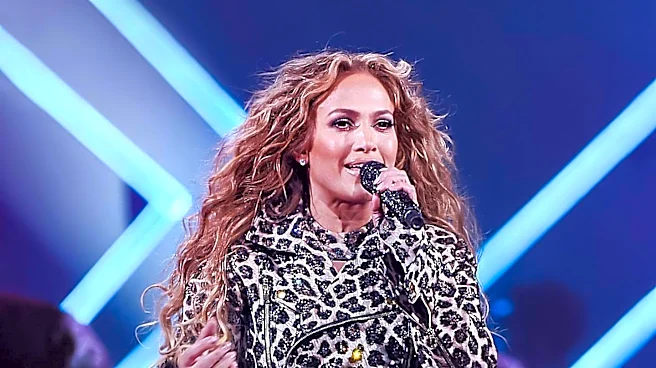
Jennifer Lopez, known as J.Lo, has offered a new perspective on Electronic Dance Music (EDM), describing it as 'emotional dance music' rather than merely electronic dance music. This redefinition stems from her recent experience performing her track 'Save
Me Tonight' with David Guetta at Coachella. The song, initially created for her European tour, gained significant fan demand, leading to its official release. Lopez observed the profound emotional connection and communal experience among the audience at Coachella, where thousands sang and danced together. She noted that in an era of increasing digital disconnection, music, particularly EDM, plays a crucial role in bringing people together and fostering shared moments. The performance also included a nostalgic moment when Guetta played her 1999 hit 'Waiting for Tonight,' further emphasizing the enduring emotional impact of dance music across decades.
Why It's Important?
J.Lo's characterization of EDM as 'emotional dance music' is significant because it elevates the genre beyond its technical definition, emphasizing its profound social and psychological impact. In a society increasingly grappling with feelings of isolation due to pervasive digital engagement, her statement highlights music's capacity to serve as a powerful antidote. This perspective can reshape public perception of EDM, moving it from a niche or purely recreational category to one recognized for its ability to foster community and emotional well-being. For the music industry, this framing could encourage artists and producers to focus more on the emotional resonance and communal aspects of their creations, potentially leading to more impactful and unifying musical experiences. It also underscores the enduring power of live music events, like Coachella, as vital spaces for collective emotional expression and connection, reinforcing their cultural and economic importance.
What's Next?
Following J.Lo's influential statement, there may be a broader cultural conversation about the emotional and communal aspects of various music genres, particularly within the dance music scene. Artists and industry professionals might increasingly adopt this 'emotional dance music' terminology, influencing how EDM is marketed, produced, and consumed. This could lead to a greater emphasis on lyrical depth and melodic richness in future EDM productions, alongside the traditional focus on beats and electronic sounds. Furthermore, event organizers may leverage this narrative to promote festivals and concerts as essential gatherings for emotional connection and shared experiences, potentially attracting a wider audience seeking communal engagement. The continued success of tracks like 'Save Me Tonight' and the nostalgic appeal of older hits like 'Waiting for Tonight' suggest a sustained demand for dance music that evokes strong emotions and fosters unity.
Beyond the Headlines
J.Lo's reinterpretation of EDM delves into the deeper psychological and sociological functions of music. By labeling it 'emotional dance music,' she touches upon the inherent human need for connection and shared experience, which music has historically fulfilled. In an age dominated by personalized digital consumption and social media, the collective effervescence experienced at live music events becomes increasingly valuable. This perspective suggests that the true power of EDM, and perhaps music in general, lies not just in its sonic qualities but in its ability to create a temporary, unifying emotional space where individuals can transcend their personal isolation. This could lead to a re-evaluation of how we measure the 'success' of music, moving beyond commercial metrics to include its capacity for fostering social cohesion and emotional catharsis. It also highlights the cyclical nature of musical influence, where older tracks can regain relevance by tapping into timeless emotional needs, demonstrating music's enduring cultural power.