






What's Happening?
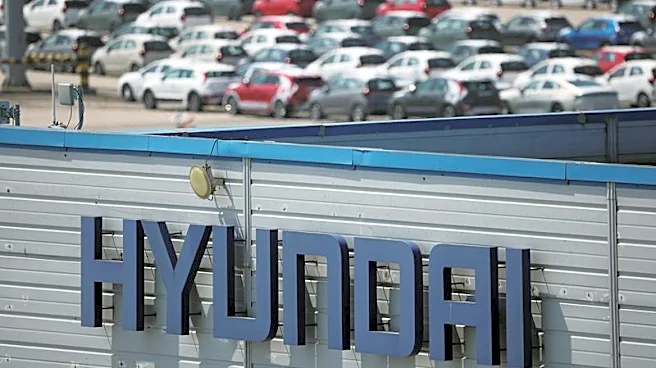
Hyundai is exploring a significant expansion of its Metaplant in Georgia, potentially increasing annual production capacity to between 700,000 and 800,000 vehicles by 2028. This expansion could establish it as the largest vehicle assembly operation in the United
States. The current capacity of the plant is 500,000 cars per year. This move is part of Hyundai's broader $26 billion U.S. investment plan, set to conclude in 2028, aimed at rapidly boosting local production. The company's CEO, Jose Muñoz, indicated that while nothing is finalized, the expansion is being considered. Hyundai aims for at least 80 percent of its U.S. vehicle sales to be locally produced by the end of the decade, a substantial increase from approximately 40 percent in 2024. The Georgia facility, announced in 2022, currently produces the Hyundai Ioniq 5 and Ioniq 9 EVs, along with the Kia Sportage Hybrid, with plans for a much broader product range.
Why It's Important?
This potential expansion by Hyundai underscores a significant shift in automotive manufacturing strategy within the U.S., largely influenced by trade policies. President Trump's tariffs, which impose a 15 percent duty on imports from South Korea, are accelerating Hyundai's localization efforts. By increasing domestic production, Hyundai can mitigate these tariff costs, making its vehicles more competitive in the U.S. market. This move also signifies a commitment to the U.S. as Hyundai's most crucial market outside of Korea, potentially creating numerous jobs and boosting the American manufacturing sector. The focus on local production for a substantial portion of its U.S. sales reflects a strategic adaptation to the evolving trade landscape and a desire to strengthen its market position against competitors like Ford, Toyota, and Jeep, particularly in segments like midsize pickups and body-on-frame SUVs. The investment also signals a long-term commitment to electric vehicle production and diversification of its product offerings within the U.S.
What's Next?
Hyundai is expected to finalize its decision regarding the Georgia plant expansion in the coming years, with the goal of reaching increased production capacity by 2028. This expansion will likely involve further investment in the Metaplant and potentially additional U.S. manufacturing facilities, particularly for body-on-frame trucks and SUVs. The company is developing an American-focused midsize pickup, previewed by the Boulder concept, which is slated for production by 2030 using locally sourced steel. This suggests a future push into segments currently dominated by other manufacturers. As Hyundai continues to roll out dozens of new models in the North American market, further capacity additions will be necessary. The company's ongoing investment and expansion plans will be closely watched by competitors and policymakers, as they reflect the broader impact of trade policies on global manufacturing strategies and the future of the U.S. automotive industry.
Beyond the Headlines
The driving force behind Hyundai's accelerated U.S. manufacturing push, particularly President Trump's tariffs, highlights a broader trend of reshoring and localization in response to protectionist trade policies. This shift has implications beyond immediate economic benefits, influencing supply chain resilience, technological development, and geopolitical considerations. By increasing domestic production, Hyundai not only avoids tariffs but also reduces its exposure to international supply chain disruptions and currency fluctuations. This strategy could encourage other foreign automakers to similarly increase their U.S. manufacturing footprint, potentially transforming the landscape of the American automotive industry. Furthermore, the focus on producing electric vehicles and specialized trucks in the U.S. aligns with national priorities for green energy and domestic industrial growth, fostering innovation and job creation in advanced manufacturing sectors. The long-term impact could be a more robust and self-sufficient U.S. automotive industry, albeit one shaped by the complexities of international trade relations.