


What's Happening?
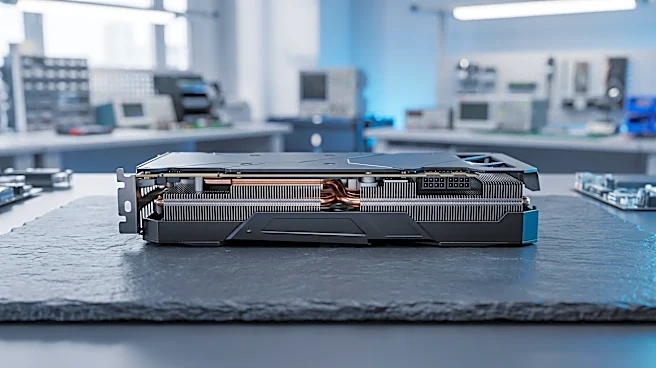
AMD is reportedly preparing another price increase for its Radeon graphics cards in November 2026, primarily driven by an 8-10% rise in GDDR6 memory costs during the third quarter. This information, originating from a supply chain source known as ChannelGate,
suggests that AMD will raise the price of its GPU and GDDR6 bundles sold to board partners. This follows a period of continuous price hikes, with retail GPU prices increasing by approximately 15% in August, 7% in September, and an average of 11% across ten countries in October. The flagship Radeon RX 9070 XT, which launched at $599 in March 2025, was listed between $916.99 and $1,063.77 on October 30, indicating a significant markup. The report highlights that while the exact percentage of the November increase is unknown, and AMD has not confirmed it, the trend of rising memory costs is expected to translate into higher retail prices for consumers.
Why It's Important?
This anticipated price hike for AMD Radeon graphics cards has significant implications for the U.S. gaming and PC building markets, particularly as the holiday shopping season approaches. Consumers hoping for Black Friday discounts on RX 9000 series cards are likely to be disappointed, as rising component costs will squeeze retailer margins and limit aggressive price cuts. System builders and OEMs will face increased costs, potentially leading to higher prices for prebuilt gaming desktops or a shift to lower-spec components. The reliance of current Radeon RX 9000 cards on GDDR6 memory, which is experiencing price inflation, puts AMD at a disadvantage compared to Nvidia's RTX 50 series, which uses GDDR7. This situation could impact AMD's competitive positioning, especially in the mid-tier market where price-sensitive buyers might opt for consoles, handhelds, or used cards instead of new GPUs. The broader memory market trend, driven by AI demand, suggests that this is a systemic issue affecting the entire industry.
What's Next?
The immediate consequence will likely be higher retail prices for AMD Radeon graphics cards reaching shelves in the coming weeks, potentially impacting holiday sales. Black Friday promotions are expected to focus on rebates, free games, or bundles rather than direct price reductions on current-generation cards. The competitive landscape between AMD and Nvidia will continue to evolve, with both brands experiencing price inflation, though Nvidia's cards have reportedly seen faster price increases. This could lead to a re-evaluation of performance-per-dollar value by consumers. Industry analysts predict that memory makers will continue to prioritize server DRAM and High Bandwidth Memory (HBM) for AI applications, indicating that a significant supply glut and subsequent price relief for gaming GPUs are unlikely before 2027. Consumers in urgent need of a graphics card are advised to purchase sooner rather than later to potentially avoid further price increases.
Beyond the Headlines
The ongoing price increases in the graphics card market, particularly for GDDR6 memory, reveal a deeper structural shift driven by the burgeoning demand for AI. The prioritization of HBM and server DRAM for AI accelerators by memory manufacturers like Samsung, SK Hynix, and Micron means that less capacity is allocated to gaming memory. This creates a persistent shortage in the gaming GPU market, even amidst softer consumer demand. This dynamic illustrates how the rapid expansion of one technological sector (AI) can inadvertently impact another (consumer electronics) by diverting critical resources. The situation challenges the traditional market correction mechanisms, where soft demand would typically lead to price reductions. Instead, prices continue to climb due to supply-side constraints, forcing consumers to adapt to a new reality where high-performance computing components are increasingly influenced by industrial and enterprise-level demands.