






What's Happening?
GlobalFoundries Inc. (GF) announced its preliminary financial results for the third quarter ended September 30, 2026, reporting a net loss of $270 million, with revenue reaching $1.899 billion, marking a 12.5% increase from the previous year. Despite
the net loss, the company highlighted strong performance in key growth markets, particularly in communications infrastructure, data centers, automotive, and Home and Industrial IoT. The reported net loss was primarily driven by a $441 million non-cash charge related to the issuance of 9.9 million ordinary shares to the U.S. government in September 2026. Concurrently, GF revealed significant strategic developments, including its selection as the technology provider and operator for two new semiconductor fabs in Malta, New York, under a U.S.-Japan initiative that could provide up to $21 billion in funding. An initial investment of approximately $10 billion will accelerate the construction of a new 300mm semiconductor fab, with capacity expected by 2029. Additionally, GF's existing CHIPS and Science Act award was amended, reallocating $955 million to support advanced semiconductor manufacturing investments in Malta, New York, and Burlington, Vermont, focusing on silicon photonics, silicon germanium, and advanced packaging.
Why It's Important?
These developments are crucial for bolstering the U.S. semiconductor supply chain and national security. The substantial investments in new fabs and advanced manufacturing capabilities in New York and Vermont directly address the U.S. government's push to onshore critical technology production, reducing reliance on foreign manufacturing, particularly from Asia. This move is expected to create thousands of high-tech jobs and foster innovation within the domestic semiconductor industry. The focus on silicon interposers, silicon photonics, and silicon germanium is particularly significant for supporting the rapidly expanding AI and high-performance computing sectors, which are vital for future technological advancements. By establishing a U.S.-based source for these components, GlobalFoundries is helping to secure the supply of essential materials for advanced packaging, a critical bottleneck in the current global semiconductor landscape. The partnerships and government funding underscore a concerted effort to regain U.S. leadership in semiconductor manufacturing, impacting economic competitiveness and technological sovereignty.
What's Next?
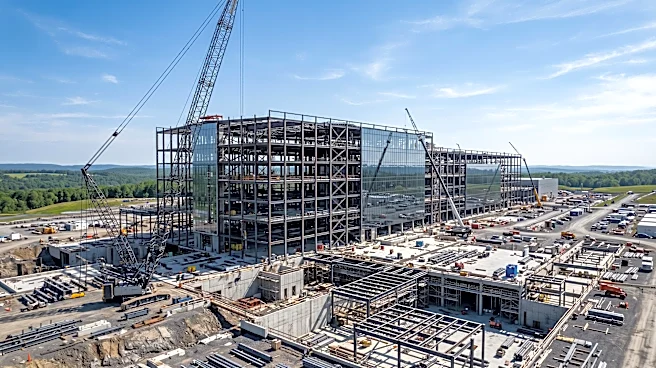
The construction of the new 300mm semiconductor fab in Malta, New York, is already underway, with volume production anticipated to begin ramping in the first half of 2028 and full capacity expected by 2029. The reallocated CHIPS and Science Act funding will accelerate investments in advanced semiconductor manufacturing at GF's facilities, with a focus on developing U.S.-based sources for silicon interposers. GlobalFoundries will continue to expand its manufacturing capacity and technological capabilities, particularly in high-performance silicon germanium technology for optical transceivers, to meet the growing demands of AI and cloud data center infrastructure. The company also plans to deploy Monolithic Power Systems' proprietary process technology at its Singapore facility, with volume production slated for early 2027, further diversifying its global manufacturing footprint. These initiatives are expected to solidify GF's position as a key player in the global semiconductor market and enhance the resilience of the U.S. technology sector.
Beyond the Headlines
The strategic investments by GlobalFoundries, supported by significant government funding, represent a broader shift towards de-globalization and regionalization of critical supply chains. This trend is driven by geopolitical tensions and the recognition of national security risks associated with over-reliance on single points of failure in global manufacturing. The emphasis on advanced packaging technologies, such as silicon interposers, highlights a growing understanding that innovation in semiconductor manufacturing extends beyond traditional transistor scaling. This focus on packaging is crucial for integrating diverse components into high-performance systems, which is essential for the next generation of AI and high-performance computing. The collaboration between the U.S. and Japan in semiconductor manufacturing also signals a strengthening of alliances aimed at securing technological leadership and diversifying supply chains away from potential geopolitical risks. This long-term strategy could reshape the global technology landscape, fostering greater resilience and innovation within allied nations.