





What's Happening?
Halliburton, a U.S. oilfield services company, has been contracted by Cornish Lithium, a British mineral company, to drill two wells for geothermal lithium extraction in Cornwall, England. The project aims to assess the concentration of lithium dissolved
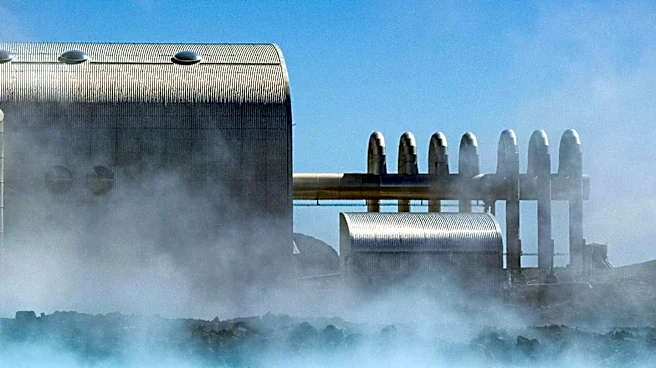
in hot water circulating beneath the Cross Lanes site. The plan involves drilling two wells, each approximately 6,560 feet deep, from a single pad: one to bring brine to the surface and another to return the stripped water. This direct lithium extraction (DLE) process uses a sorbent material to capture lithium ions, avoiding open-pit mining or evaporation ponds. Cornish Lithium will operate a modular demonstration plant on-site to test the DLE process at a near-commercial scale. Halliburton's role includes subsurface modeling, well engineering, and providing equipment and services for drilling and testing. The drilling and testing program is budgeted at £14.5 million (approximately $19.6 million), with half funded by a UK government grant.
Why It's Important?
This collaboration between a U.S. oilfield giant and a British lithium startup highlights a significant shift in the energy and mining sectors, leveraging traditional oil and gas expertise for critical mineral extraction. For Halliburton, it represents a diversification into the burgeoning lithium market, showcasing the adaptability of its drilling technologies to new applications beyond hydrocarbons. For the U.S. and its allies, securing a stable supply of lithium is crucial for the transition to electric vehicles and renewable energy storage, reducing reliance on foreign sources. The DLE method, if proven scalable and efficient, could offer a more environmentally friendly alternative to conventional lithium mining, addressing concerns about water usage and land disturbance. The success of this project could set a precedent for similar ventures globally, potentially accelerating the development of domestic lithium resources and strengthening supply chains for green technologies.
What's Next?
The immediate next step is the commencement of drilling operations, though a specific start date has not been announced. Following the drilling, a three-month flow test will be conducted to measure the lithium concentration in the deeper water, which is crucial for determining the project's commercial viability. This data will inform the final investment decision (FID) for Cornish Lithium. If the water tests show higher lithium concentrations than previous exploration boreholes, the company plans to develop a network of modular geothermal lithium hubs across Cornwall, potentially generating geothermal heat for local homes and businesses as a secondary revenue stream. Conversely, if the concentrations are not commercially viable, the Cross Lanes project may remain an expensive scientific endeavor. The project's progress will be closely watched by the global mining and energy industries, as it could influence future investment and technological adoption in direct lithium extraction.
Beyond the Headlines
The partnership between Halliburton and Cornish Lithium underscores a broader trend of convergence between the traditional energy sector and the clean energy transition. Oilfield service companies, with their extensive experience in subsurface engineering and drilling, are uniquely positioned to facilitate the extraction of critical minerals like lithium, which are essential for decarbonization. This move could help re-skill and re-deploy a workforce traditionally focused on fossil fuels, contributing to a just transition. Furthermore, the project highlights the strategic importance of domestic critical mineral production for national security and economic resilience, reducing dependence on potentially unstable supply chains. The environmental implications of DLE, particularly its potential to minimize ecological footprints compared to conventional methods, could also set new standards for responsible mining practices. The success or failure of this project will not only impact the companies involved but also influence policy decisions regarding critical mineral extraction and the role of established industries in the green economy.