









What's Happening?
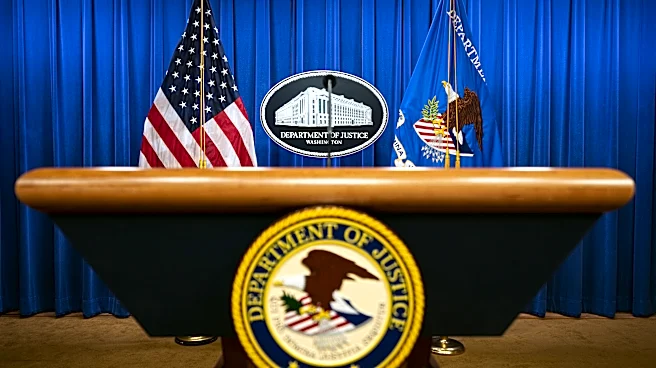
The U.S. Department of Justice announced charges against three individuals for their alleged involvement in a deepfake fraud scheme that defrauded companies worldwide of over $129 million. The fraudsters reportedly used AI-generated voices and images
to impersonate executives and lawyers, convincing employees to transfer funds to accounts controlled by the group. The scheme operated between 2024 and 2026, with the accused contacting employees while posing as their chief executives to request help with confidential financial transactions. They then allegedly used AI to mimic the executive's voice or image during calls. Employees were subsequently directed to purported lawyers, also impersonated by the group, to legitimize the transactions before providing bank details for large transfers. Identified losses include approximately $4.8 million from a Missouri hospital system, $2.7 million from a Rhode Island bank, and $11.6 million from a UK fintech company. The indictment alleges that the stolen money was sent to accounts in multiple countries and converted into cryptocurrency to obscure its origin. Three individuals have been charged and arrested in Spain and the UK, with extradition requests pending.
Why It's Important?
This case highlights the escalating threat of AI-powered deepfake technology in financial fraud, demonstrating how sophisticated impersonation tactics can bypass traditional security measures and lead to significant financial losses for businesses. The use of AI to mimic voices and images makes it increasingly difficult for employees to verify the authenticity of urgent or unusual requests, exploiting human trust and the perceived authority of executives. The global nature of the scheme, involving companies and bank accounts across multiple countries, underscores the complex challenges law enforcement faces in combating such crimes. The conversion of stolen funds into cryptocurrency further complicates tracing and recovery efforts, posing a substantial risk to financial institutions and corporate security protocols. This incident serves as a critical warning for organizations to enhance their internal verification processes and employee training to counter advanced social engineering attacks facilitated by AI.
What's Next?
The three individuals charged are currently awaiting extradition from Spain and the UK to face justice in the U.S. The ongoing legal proceedings will likely shed more light on the operational details of the deepfake fraud scheme and could lead to further arrests or charges. Companies are expected to review and strengthen their financial security protocols, particularly regarding large transfers and changes to bank details, to prevent similar incidents. The Justice Department and other law enforcement agencies will likely continue to emphasize the importance of verifying unexpected requests through independent channels and reporting suspicious activities. This case may also prompt discussions about the need for more robust regulatory frameworks and technological solutions to detect and prevent AI-generated fraud.
Beyond the Headlines
The deepfake fraud scheme exposes a critical vulnerability in corporate security: the human element. While technology advances, the reliance on human judgment in verifying identities and transactions remains a weak point that fraudsters are increasingly exploiting with AI. This incident raises ethical questions about the responsible development and deployment of AI technologies, particularly those capable of generating realistic human likenesses. The ease with which AI can be weaponized for deception could erode trust in digital communications and transactions, necessitating a broader societal conversation about digital identity verification and the authenticity of online interactions. The case also underscores the evolving cat-and-mouse game between cybercriminals and cybersecurity experts, pushing the boundaries of what constitutes a 'trusted' interaction in the digital age.