








What's Happening?
Texas Instruments (TI) has introduced two new devices aimed at improving connectivity in factory automation, robotics, and Industrial Internet of Things (IIoT) systems. The new offerings include a multiprotocol communications system-on-module (SoM), the
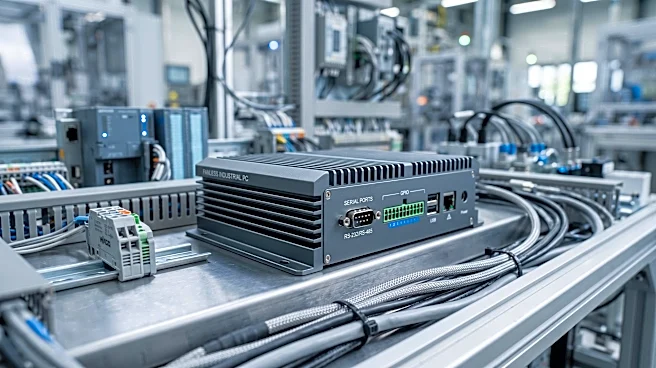
TICS100MOD, and an IO-Link master, the TIOM2212. These products expand TI’s industrial communication portfolio, enabling engineers to utilize various established industrial communication protocols on a single hardware platform. The TICS100MOD, built with TI’s AM2612 microcontroller and DP83826AI Ethernet physical layer, is a compact, certified module that supports multiple real-time Industrial Ethernet protocols like EtherCAT, EtherNet/IP, and Profinet. Its firmware-based switching capability allows engineers to adapt to different networking requirements without hardware changes. The TIOM2212 IO-Link master facilitates the connection of IO-Link devices to higher-level Industrial Ethernet networks, bridging TI’s multiprotocol approach to the sensor and actuator level. These solutions integrate programmable hardware with certified, ready-to-use software to simplify system integration and ensure reliable industrial networking.
Why It's Important?
The introduction of TI's new multiprotocol Ethernet module and IO-Link master is significant for U.S. industries, particularly in manufacturing and automation. Traditional industrial setups often require separate hardware for each communication protocol, leading to increased costs, design complexity, and longer development times. TI's new single-platform approach addresses these challenges by offering protocol flexibility through firmware updates, reducing the need for hardware redesigns. This innovation can accelerate the development and deployment of advanced factory automation systems, making them more adaptable to evolving industry standards and regional requirements. For businesses, this means potentially lower operational costs, streamlined supply chains by sourcing hardware and software from a single vendor, and reduced risks associated with managing multiple components. The enhanced connectivity and real-time performance across diverse protocols will enable more efficient data exchange between equipment on the production floor, fostering greater productivity and innovation in connected factories across the U.S.
What's Next?
The immediate next step for Texas Instruments involves showcasing its new multiprotocol industrial communications technology at industry events, such as electronica in Munich, Germany. This will allow potential customers and partners to see the TICS100MOD SoM in action through demonstrations. Following this, TI will focus on broader market adoption, providing evaluation modules and software development kits (SDKs) with certified, production-ready protocol stacks to accelerate customers' time to market. Engineers in industrial automation, robotics, and IIoT sectors are expected to begin integrating these new solutions into their next-generation designs. The flexibility offered by firmware-based protocol switching will likely lead to increased demand for these integrated solutions as companies seek to future-proof their industrial networks. Over time, this could drive a shift towards more unified and adaptable industrial communication architectures, reducing the complexity and cost associated with managing diverse communication protocols in manufacturing environments.
Beyond the Headlines
Beyond the immediate technical advantages, TI's new multiprotocol solutions signal a broader strategic shift in the industrial automation sector towards greater integration and flexibility. The ability to switch between different Industrial Ethernet protocols via firmware on a single hardware platform could fundamentally alter how industrial equipment is designed, deployed, and maintained. This approach reduces reliance on specialized hardware for each protocol, potentially leading to more standardized and interoperable industrial systems. Ethically, this could foster a more open ecosystem where different manufacturers' equipment can communicate more seamlessly, reducing vendor lock-in and promoting innovation. Legally, as industrial systems become more interconnected, there will be increased scrutiny on cybersecurity and data integrity across these multiprotocol networks. Culturally, this move supports the ongoing digital transformation of manufacturing, pushing industries towards smarter, more connected factories that can adapt quickly to technological advancements and market demands, ultimately enhancing the competitiveness of U.S. industries on a global scale.