






What's Happening?
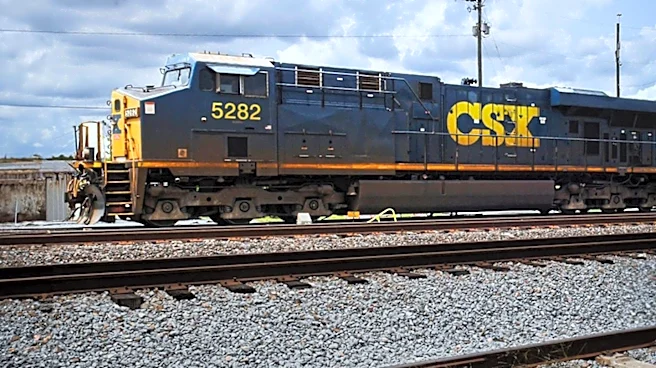
CSX Corporation, a major rail-based freight transportation provider in the United States and Canada, is currently trading at a premium valuation compared to its industry peers. The company's forward 12-month price-to-earnings ratio (P/E-F12M) stands at 22.37X,
which is higher than the industry's 21.60X over the past five years and above the median level of 17.35X. This elevated valuation has led to a 'Value Score' of F. Despite these valuation concerns, CSX's outlook is supported by rising freight volumes, disciplined pricing strategies, and cost reductions across its rail network. Management has increased its full-year revenue, margin, and free cash flow expectations. The company is also benefiting from new intermodal services, truck-to-rail conversions, and ongoing improvements in safety performance through employee training and technology investments. Furthermore, CSX has strengthened labor relations through multi-year agreements with its unionized workforce, aiming for greater stability.
Why It's Important?
The valuation of CSX Corporation is a critical indicator for investors and the broader transportation sector. A high P/E ratio suggests that the market has high expectations for future earnings growth, but it also increases the stock's sensitivity to any negative changes in investor sentiment, service performance, or profitability. For the U.S. economy, CSX's performance is significant as it plays a vital role in freight transportation, impacting various industries from automotive to general merchandise. The company's efforts in expanding its network capacity, improving safety, and strengthening labor relations contribute to the efficiency and reliability of the national supply chain. However, challenges such as service variability, fuel-price fluctuations, and labor inflation could disrupt progress, potentially affecting the cost and timeliness of goods movement across the country. The company's exposure to coal transportation also presents a long-term risk due to evolving energy generation mixes.
What's Next?
While CSX's management has a positive outlook, supported by favorable estimate revisions from brokers, investors are advised to await a more opportune entry point for purchasing the stock. For current shareholders, retaining the stock is suggested. The company's focus on productivity and capital spending below $2.4 billion for 2026 is expected to maintain solid funding flexibility. However, heavier investment or weaker earnings could pressure free cash flow conversion. CSX will continue to address challenges such as maintaining consistent service quality amidst increasing freight volumes, managing crew availability, and optimizing terminal capacity. The company's ongoing efforts in technology adoption and network capacity investments are crucial for sustaining operational efficiency and long-term profitability. The impact of broader labor agreements and continued shareholder distributions will also be closely watched as they contribute to the company's operating and shareholder-return profile.
Beyond the Headlines
The situation with CSX Corporation highlights a broader tension in the market between strong operational performance and elevated stock valuations. While CSX demonstrates robust fundamentals through increased freight volumes, cost controls, and improved safety, its premium valuation raises questions about the sustainability of its growth trajectory and its vulnerability to market corrections. This scenario underscores the importance of a balanced investment approach, where operational strengths are weighed against market expectations and potential risks. The company's strategic shift towards intermodal services and truck-to-rail conversions reflects a larger trend in the transportation industry to optimize logistics and reduce environmental impact, which could have long-term benefits for efficiency and sustainability. However, the persistent structural and cyclical risks associated with coal transportation illustrate the ongoing challenges faced by traditional industries in adapting to evolving energy landscapes and environmental regulations.