



What's Happening?
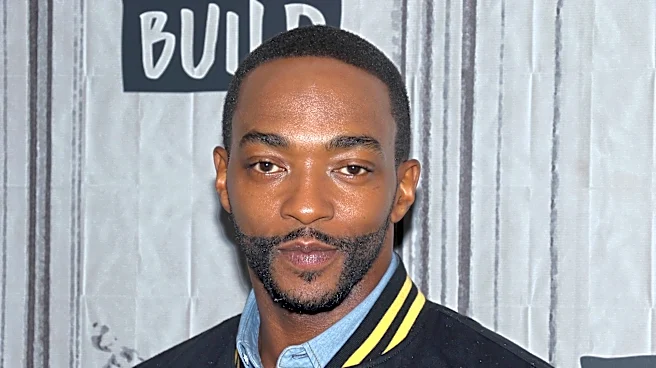
Actor Anthony Mackie, known for his roles in the Marvel Cinematic Universe, recently shared his perspective on the late rapper Tupac Shakur, whom he has portrayed twice. During the November 25 episode of 'On Film... With Kevin McCarthy,' Mackie explained
his belief that figures like 2Pac, Elvis, Bob Marley, and Muhammad Ali exist in 'three different realities.' He elaborated that these realities include their tangible, three-dimensional presence, the public's perception of them based on media and hearsay, and the individual reality each fan constructs based on their personal connection to the artist's work. Mackie, who played 2Pac in the 2001 off-Broadway play 'Up Against the Wind' and the 2009 musical biopic 'Notorious,' noted that it's impossible to portray 2Pac in a way that satisfies everyone due to these varied perceptions. He recalled that 2Pac's mother, Afeni Shakur, personally selected him for the role in 'Notorious' after seeing his performance in the stage play.
Why It's Important?
Mackie's insights offer a significant contribution to the ongoing cultural discourse surrounding iconic figures and their legacies. His concept of 'three realities' highlights the complex interplay between an artist's actual life, their public image, and the deeply personal interpretations formed by their audience. This perspective is crucial for understanding how public figures are remembered and how their narratives evolve over time, particularly in the age of widespread media and fan engagement. For the entertainment industry, it underscores the challenges and responsibilities involved in portraying historical or beloved figures, as any depiction will inevitably clash with some segment of the audience's preconceived notions. This discussion also sheds light on the enduring impact of artists like 2Pac, whose influence continues to be debated and reinterpreted decades after their passing, affecting how their work is consumed and understood by new generations.
What's Next?
The discussion surrounding Anthony Mackie's interpretation of 2Pac's legacy is likely to continue to resonate within fan communities and among cultural critics. Such commentary often sparks renewed interest in the artist's work and previous portrayals, potentially leading to re-evaluations of films like 'Notorious' or the off-Broadway play 'Up Against the Wind.' This could also influence future biographical projects about iconic figures, encouraging creators to consider the multifaceted nature of public perception. Furthermore, Mackie's perspective might inspire other actors and biographers to articulate their own approaches to embodying complex historical personalities, fostering a deeper conversation about authenticity and interpretation in biographical storytelling. The ongoing release of archival material, such as 'The Tupac Tapes' on Netflix, further contributes to these evolving narratives, providing new contexts for understanding 2Pac's life and impact.
Beyond the Headlines
Mackie's concept extends beyond mere celebrity portrayal, touching upon broader philosophical questions about identity, perception, and collective memory. It suggests that the 'truth' of a public figure is not singular but rather a composite of objective facts, mediated narratives, and subjective experiences. This has profound implications for how society constructs and consumes history, particularly in an era where information is abundant but often fragmented or biased. Ethically, it raises questions about the responsibility of biographers and media outlets to present a nuanced view that acknowledges these multiple realities, rather than promoting a singular, potentially reductive narrative. Culturally, it highlights the power of individual interpretation in shaping legacies, demonstrating how fans actively participate in the ongoing creation of an artist's meaning, long after their physical presence is gone. This dynamic interplay between creator, media, and audience forms a complex tapestry of cultural understanding.