
What's Happening?
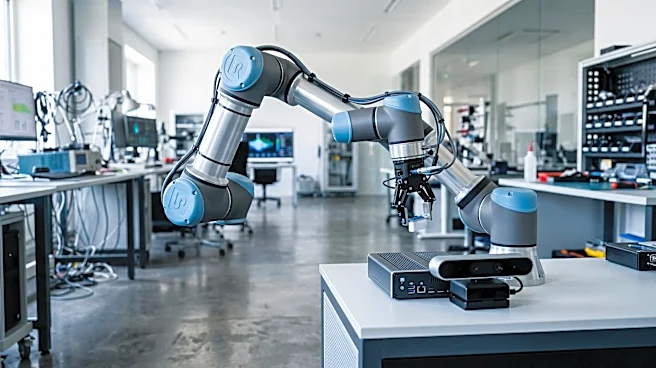
Universal Robots has integrated Inbolt’s AI-powered 3D vision guidance directly into its latest generation of collaborative industrial robots, the Gen 7 platform. This integration, announced at the SPS
2026 exhibition in Nuremberg, Germany, allows Inbolt Standard vision guidance software to run natively on the robot's CB7 Core controller, eliminating the need for a separate industrial computer. The system utilizes a wrist-mounted 3D camera to recognize components based on their CAD files, enabling robots to adapt their programmed trajectories to the actual position of each part during production cycles. This advancement simplifies robotic vision by allowing direct camera connection to the robot’s tool flange via integrated Ethernet and power connections, removing the need for external cable routing. The technology has already demonstrated significant improvements, such as a 91% reduction in tightening failures at a Stellantis engine-tightening station, with vision processing taking only 0.5 seconds per engine. This collaboration, which began in 2022, has already seen vision-guided robotic systems deployed in manufacturing facilities across Europe and North America.
Why It's Important?
This integration is significant for U.S. manufacturing industries, particularly automotive, electronics, and data center hardware, as it expands the range of tasks that can be automated with greater efficiency and reduced complexity. By eliminating the need for external computing hardware and simplifying setup, manufacturers can deploy vision-guided cobots across numerous stations and plants more easily and cost-effectively. The ability to train the software to recognize new components from CAD files in under 10 minutes, without extensive image dataset collection, significantly reduces integration time and operational overhead. This leads to increased productivity, reduced errors, and enhanced flexibility in production lines, allowing U.S. companies to adapt more quickly to new product introductions. The local processing of production data also addresses data security concerns, as no sensitive information leaves the factory floor. This technological leap makes advanced automation more accessible, potentially boosting competitiveness and innovation within U.S. manufacturing sectors.
What's Next?
In the coming months, Inbolt plans to bring more of its product range to Universal Robots customers, further expanding the capabilities available for industrial automation. Manufacturers standardizing on Universal Robots across multiple sites can now consider vision guidance as a standard option for every new cell from day one, streamlining their automation strategies. The continued development and deployment of such integrated AI solutions are expected to drive further adoption of collaborative robots in diverse industrial applications, including screwdriving, machine tending, rack loading, and depalletizing. This will likely lead to increased demand for skilled technicians capable of deploying and maintaining these advanced robotic systems. The partnership's success in reducing errors and integration times suggests a trend towards more seamless and intelligent automation solutions becoming standard in U.S. factories, potentially influencing future investment in AI-driven robotics and workforce training initiatives.
Beyond the Headlines
The direct integration of AI vision into robotic platforms represents a broader shift towards 'physical AI,' where intelligent capabilities are embedded directly into hardware, making robots more autonomous and adaptable. This development has profound implications for the future of work in the U.S., potentially leading to a redefinition of roles on the factory floor, with a greater emphasis on oversight, programming, and maintenance rather than repetitive manual tasks. Ethically, the increased autonomy of robots raises questions about human-robot collaboration and the balance between automation efficiency and human employment. Legally, as these systems become more sophisticated, there may be evolving considerations regarding liability in cases of operational errors or system failures. Culturally, the widespread adoption of such advanced robotics could further accelerate the digital transformation of industries, pushing for a more technologically literate workforce and fostering innovation in related fields like AI development and sensor technology.