








What's Happening?
Albany Engineered Composites (AEC), a segment of Albany International Corp. (NYSE: AIN), has been awarded a new contract valued at $21.2 million over 30 months. This contract, secured through the U.S. government's Industrial Base Analysis and Sustainment
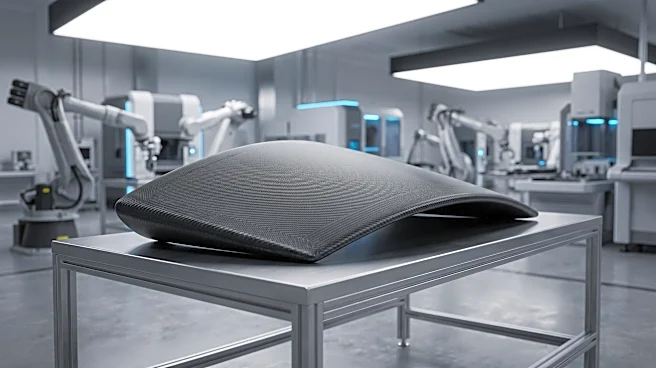
(IBAS) program for Strengthening America's Manufacturing and Defense Industrial Base (SAMDIB), focuses on advancing the manufacturing capabilities of carbon-carbon composite thermal protection systems (TPS). These systems are crucial for hypersonic vehicles and solid rocket motors (SRM), which operate in extreme aerospace and defense environments. The award, facilitated by the U.S. Army Contracting Command – Rock Island and Cornerstone Other Transaction Authority (OTA), aims to establish scalable manufacturing capabilities for these critical defense applications. AEC will leverage its expertise in advanced composite manufacturing, including 3D-woven, near-net-shape preforms and Resin Transfer Molding (RTM), combined with carbon-carbon densification capabilities.
Why It's Important?
This contract is vital for strengthening the U.S. defense industrial base by addressing a critical need for domestic manufacturing capacity of advanced thermal protection systems. Hypersonic systems and solid rocket motors are key components of next-generation defense technologies, and their performance heavily relies on materials that can withstand extreme conditions. By investing in vertically integrated production facilities for carbon-carbon composites, the U.S. government aims to ensure a reliable and scalable supply chain for these essential components, reducing dependence on foreign sources and bolstering national security. This initiative will also drive innovation in advanced materials technology and manufacturing processes, creating high-tech jobs and fostering economic growth within the defense sector. The ability to produce these systems cost-effectively and at scale is paramount for the continued development and deployment of advanced U.S. military capabilities.
What's Next?
Over the next 30 months, Albany Engineered Composites will focus on developing and establishing a vertically integrated production facility for carbon-carbon composite manufacturing. This effort will involve engineering studies, facility planning, supplier selection, procurement and installation of key manufacturing equipment, and the development of necessary infrastructure. The program is designed to create critical domestic industrial base capacity, ensuring the continued development and scalable production of cost-effective thermal protection solutions for hypersonic weapons and SRMs. This will likely lead to further advancements in composite materials and manufacturing techniques, potentially opening doors for additional defense contracts and applications. The successful implementation of this contract will be closely watched by stakeholders in the defense industry and government, as it directly impacts the readiness and technological superiority of U.S. military forces.
Beyond the Headlines
The award to Albany Engineered Composites signifies a broader strategic shift towards enhancing domestic manufacturing capabilities for critical defense technologies. This move is not just about securing a supply chain but also about fostering a resilient and innovative industrial base that can adapt to evolving geopolitical landscapes and technological demands. The emphasis on advanced composite materials like carbon-carbon composites highlights the increasing importance of lightweight, high-strength, and extreme-environment-resistant materials in modern warfare. Furthermore, the investment in scalable manufacturing processes underscores a commitment to not only developing cutting-edge technologies but also ensuring their mass production feasibility. This could have long-term implications for material science research and development, potentially leading to spin-off applications in commercial aerospace and other high-performance industries, thereby creating a ripple effect of technological advancement and economic benefit.