




What's Happening?
Rivian Automotive's most profitable business is its software and services division, which significantly contributes to its gross profit, according to recent financial reports. This segment, which includes work for a joint venture with Volkswagen Group,
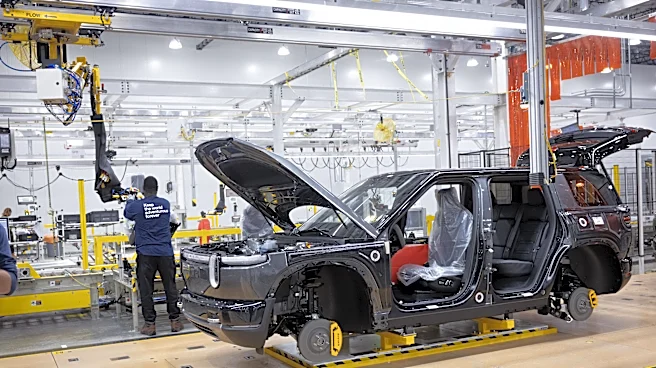
generated a gross profit of $256 million last quarter, achieving a 42% margin. In contrast, the company's car manufacturing segment experienced an $80 million loss at the same level. The software and services segment's revenue growth was 45% from the previous year, with approximately 60% of its revenue, or $354 million, stemming from the joint venture with Volkswagen Group. This growth is primarily attributed to electrical systems and software development, alongside revenue from repairs, maintenance, and the Autonomy+ subscription service. Despite the profitability of its software arm, Rivian Automotive as a whole reported an operating loss of $881 million last quarter, and its stock price has seen a 30.5% decline over the past three months.
Why It's Important?
This development highlights a significant shift in Rivian Automotive's business model and revenue streams, indicating that its technological and service offerings are currently more financially robust than its core vehicle manufacturing. The strong performance of the software and services segment, particularly its high-profit margin and substantial contribution from the Volkswagen Group joint venture, suggests a potential pathway for the company's long-term financial stability and growth. For investors, this re-evaluation of Rivian's profitability drivers is crucial, as the company's overall stock performance has been negatively impacted by its vehicle manufacturing losses. The reliance on software and services could position Rivian as a technology company with a manufacturing arm, rather than solely a carmaker, potentially attracting a different class of investors and influencing its valuation. This also underscores the increasing importance of software and integrated services in the automotive industry, where traditional manufacturing margins are often tighter.
What's Next?
The future trajectory for Rivian Automotive will likely involve a continued focus on expanding its software and services capabilities, potentially seeking new partnerships or further developing its existing offerings to capitalize on this profitable segment. The company will need to address the financial losses in its vehicle manufacturing division to improve overall profitability and investor confidence. This could involve optimizing production processes, reducing manufacturing costs, or adjusting pricing strategies for its electric vehicles. Investors will be closely watching whether the profitability of the software segment can eventually offset the losses from car production and lead to positive free cash flow, which was reported as minus $4.19 billion over the past four quarters. The company's ability to convert its software success into overall financial health will be critical for its stock performance and market perception.
Beyond the Headlines
The emergence of Rivian's software and services as its most profitable business segment points to a broader trend in the automotive industry: the increasing value of intellectual property and recurring revenue streams over traditional hardware sales. This shift could redefine what it means to be an 'automotive company,' moving towards a model where software, data, and connectivity are as, if not more, valuable than the vehicles themselves. This also raises questions about the long-term sustainability of traditional manufacturing-heavy business models in the face of evolving technological landscapes. Companies that can successfully integrate and monetize software and services alongside their physical products may gain a significant competitive advantage. For Rivian, this strategy could provide a buffer against the capital-intensive nature and inherent risks of vehicle production, potentially allowing it to weather market fluctuations more effectively and innovate across both its hardware and software divisions.