



What's Happening?
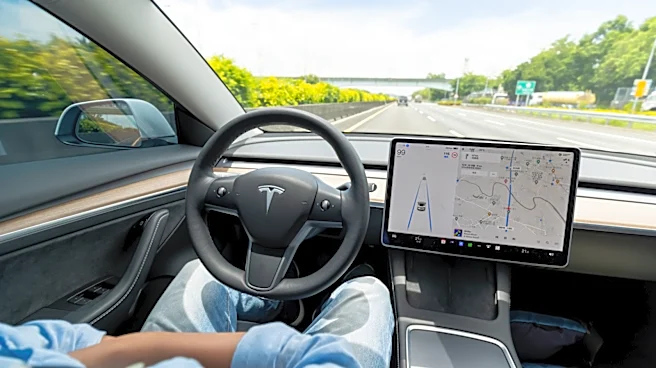
Tesla has begun rolling out version 15 of its Full Self-Driving (FSD) software, offering selected customers early access to the update. A key feature of this new version is 'Reality View,' an on-screen display that generates an AI-powered representation
of the car's surroundings. This visual update replaces the previous simplified display, which showed a basic Tesla vehicle on a white road surrounded by gray blocks for other cars. The new 'Reality View' now depicts traffic, pedestrian crossings, buildings, and floating arrows indicating the route. Elon Musk, CEO of Tesla, compared the visual experience to a video game, specifically 'GTA,' noting that it uses real-time AI video generation. Ashok Elluswamy, Vice President for AI Software at Tesla, highlighted the practical benefit of the system, stating it 'communicates the intention of the car.' Tesla claims the update also brings improvements in navigation, parking, pothole avoidance, and the detection of animals and objects on the road, asserting a 25-fold improvement in handling safety-critical situations, though specific measurement data was not provided.
Why It's Important?
The introduction of 'Reality View' in Tesla's FSD v15 marks a significant step in the evolution of autonomous driving interfaces, potentially influencing user perception and trust in self-driving technology. By presenting a more detailed and visually engaging representation of the vehicle's environment, Tesla aims to enhance the driver's understanding of the system's actions and intentions. This could be crucial for the broader adoption of FSD, as clearer communication from the vehicle's AI might alleviate some of the anxieties associated with autonomous features. The comparison to video games by Elon Musk also highlights a trend towards gamification in automotive technology, which could attract a younger, tech-savvy demographic. However, the lack of detailed data supporting the claimed 25-fold safety improvement could raise questions among regulators and safety advocates, potentially impacting the pace of FSD deployment and public acceptance. The continuous development of FSD also positions Tesla as a leader in AI-driven automotive innovation, pushing competitors to accelerate their own autonomous driving research and development.
What's Next?
Tesla plans a wider official launch of FSD v15 in December, following the current limited access for selected customers. As the update becomes more widely available, there will likely be increased scrutiny from both users and industry experts regarding its performance and safety claims. The company will need to provide more transparent data to substantiate its assertions about improved safety and functionality, especially concerning the 25-fold enhancement in handling safety-critical cases. Regulatory bodies may also take a closer look at the 'Reality View' feature and its implications for driver attention and interaction with the autonomous system. The ongoing rollout will serve as a real-world test for the new AI video generation technology, potentially revealing further areas for improvement or new challenges. Competitors in the autonomous vehicle space will undoubtedly be observing Tesla's progress closely, which could lead to accelerated innovation and new feature introductions across the industry.
Beyond the Headlines
The 'Reality View' feature in Tesla's FSD v15 touches upon deeper implications concerning the human-machine interface in autonomous vehicles. The shift from a simplified, abstract representation to a more 'realistic', video-game-like display could fundamentally alter how drivers interact with and perceive their cars' autonomous capabilities. While it aims to communicate the car's intentions more clearly, there's a potential for drivers to become overly reliant on the visual display, possibly diverting attention from the actual road, despite the system remaining a supervised driver-assistance feature. This raises ethical questions about the balance between providing informative visual feedback and ensuring driver engagement and responsibility. The use of real-time AI video generation also highlights the increasing sophistication of AI in interpreting and rendering complex environmental data, pushing the boundaries of what's possible in automotive technology. This development could set a precedent for future in-car displays, moving towards more immersive and interactive experiences, but also necessitating careful consideration of cognitive load and safety implications.