




What's Happening?
French startup Genesis AI announced a significant $500 million Series A funding round on November 17, 2026, elevating its valuation to $3.5 billion. This substantial investment, with Nvidia participating, is earmarked for the mass-scale deployment of
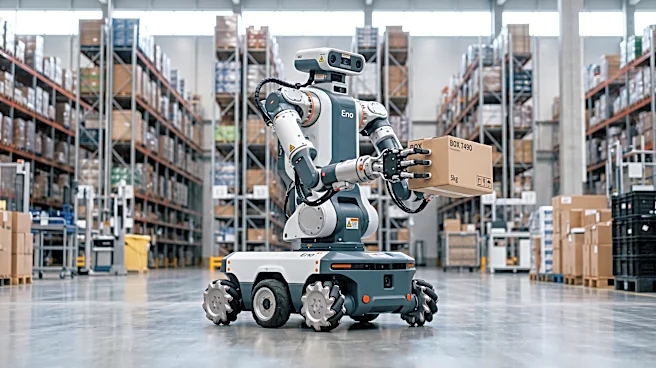
its flagship robot, Eno. Eno is designed with two arms, dexterous hands, and a wheeled mobile base, prioritizing human-like capabilities over human appearance. Genesis AI's core innovation lies in its robotics AI model, GENE, which leverages virtual simulations and data collected from workers wearing sensor-equipped gloves. This method aims to replicate the precision and complexity of human movements efficiently. The company has already produced between 30 and 40 Eno robots and is conducting pilot programs with several undisclosed clients. The initial focus for deployment will be in the manufacturing and logistics sectors, where the demand for advanced automation is high.
Why It's Important?
This funding round is crucial for Genesis AI as it positions the company to become a significant player in the rapidly evolving robotics and automation industry. The company's unique approach to robot training, utilizing sensor gloves worn by human workers, could drastically reduce data collection costs and improve efficiency compared to traditional teleoperation methods. If successful, this could accelerate the development and deployment of highly capable robots in various industrial settings. The ability to replicate complex human movements with greater precision could lead to increased productivity, reduced labor costs, and enhanced safety in manufacturing, logistics, and laboratory environments. However, the long-term viability will depend on overcoming challenges related to robot reliability, durability, and safety, especially given reports of robot hands wearing out after a few weeks of regular use and occasional fumbling during demonstrations. The success of Genesis AI could set a new standard for how robots are trained and integrated into human workflows.
What's Next?
Genesis AI plans to utilize the newly acquired $500 million to expand its data collection efforts and initiate mass-scale deployment of its Eno robots. The immediate next steps involve scaling up production of Eno and deepening its pilot programs with existing and new customers in manufacturing and logistics. The company will need to address the reported issues concerning the durability of its robot hands and refine its AI models to ensure consistent and reliable performance in real-world industrial applications. Further development will likely focus on enhancing the robustness of Eno's hardware and software to meet the rigorous demands of industrial environments. The company's ability to demonstrate consistent performance and cost-effectiveness will be critical in securing broader adoption and establishing its market presence. Competitors and potential customers will closely watch Genesis AI's progress in deploying Eno and proving its long-term operational efficiency.
Beyond the Headlines
The significant investment in Genesis AI highlights a broader trend in the robotics industry: the pursuit of more human-centric and adaptable automation solutions. By focusing on replicating human dexterity and movement rather than appearance, Genesis AI is tapping into a critical need for robots that can perform complex tasks in unstructured or semi-structured environments. This approach could lead to a paradigm shift in how industries view automation, moving beyond repetitive tasks to more intricate operations that traditionally required human intervention. The ethical implications of such advanced robotics, particularly concerning job displacement and the future of human labor in manufacturing and logistics, will become increasingly prominent. Furthermore, the reliance on human-collected data via sensor gloves raises questions about data privacy, worker monitoring, and the potential for bias in robot training. The long-term success of Genesis AI and similar companies will depend not only on technological prowess but also on navigating these complex societal and ethical considerations.