

What's Happening?
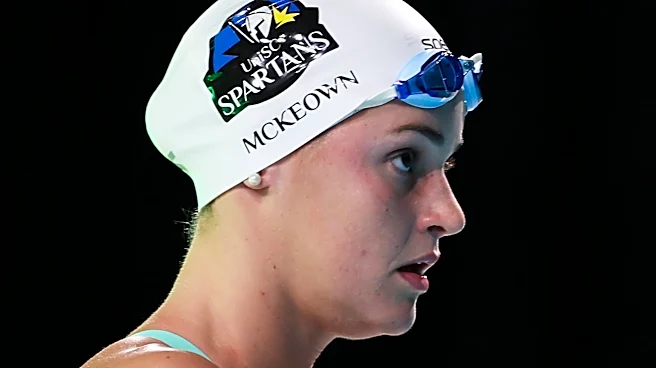
Kaylee McKeown, a dual world record holder in the 200m backstroke, has made a successful return to competitive swimming by winning the 50m backstroke elimination skins event at the Swim GP in Melbourne. This victory marks her comeback after missing the Glasgow
Commonwealth Games and Pan Pacs due to glandular fever. McKeown, representing the Tsunami team, out-touched fellow Paris Olympian Iona Anderson in a thrilling final. The Swim GP, described as a 'made-for-television exhibition competition,' features a colorful teams format and is not an officially sanctioned World Aquatics Meet, meaning no official results or records are made. Despite the unofficial nature, the event provided a platform for athletes, including many members of Australia's 24-strong Dolphins team for the upcoming World Short Course Championships in Beijing, to compete. McKeown acknowledged her recovery has been challenging, stating her body hasn't recovered as quickly as it could, but expressed relief that her illness occurred this year rather than next, when more significant competitions are scheduled.
Why It's Important?
McKeown's return to form is significant for the competitive swimming landscape, particularly as major international events like the World Short Course Championships and the Olympics approach. Her ability to win a high-intensity event like the 50m backstroke elimination skins, even while still regaining full strength, underscores her resilience and talent. For the Australian swimming team, her successful comeback provides a morale boost and indicates a strong potential contender for future medals. The Swim GP itself, while unofficial, serves as a crucial pre-event competition, allowing athletes to gauge their performance and build camaraderie before officially sanctioned meets. This type of event also helps maintain public interest in swimming outside of major championships, offering an entertaining format that engages both athletes and spectators. Her performance suggests that despite the setback of glandular fever, McKeown remains a formidable force in backstroke, which could influence medal prospects for Australia in upcoming global competitions.
What's Next?
Kaylee McKeown will continue her recovery and training, with the goal of building back to her previous performance levels. Her participation in the Swim GP serves as a stepping stone towards more significant competitions. Many of the athletes who competed in the Swim GP, including McKeown, are part of the Australian team preparing for the World Short Course Championships in Beijing, scheduled to begin on December 1. This event will be a more formal test of their current form and readiness. McKeown's focus will likely be on regaining her full endurance and speed to be in peak condition for these international championships and, ultimately, the next Olympic cycle. Her progress will be closely watched as she aims to reassert her dominance in backstroke events on the global stage.
Beyond the Headlines
McKeown's journey highlights the physical and mental challenges elite athletes face when recovering from illness or injury. Her candid admission about the difficulty of her comeback provides a relatable perspective on the demanding nature of professional sports. The 'made-for-television' format of the Swim GP also points to a broader trend in sports, where exhibition events are increasingly used to engage audiences and provide competitive opportunities outside of traditional, highly regulated meets. This approach can offer athletes more flexibility and a less pressured environment to test their skills, while also generating public interest. The emphasis on team formats and entertainment, rather than just official records, reflects an evolving strategy to broaden the appeal of swimming and connect with a wider audience, potentially influencing how other sports might adapt their competitive structures.