





What's Happening?
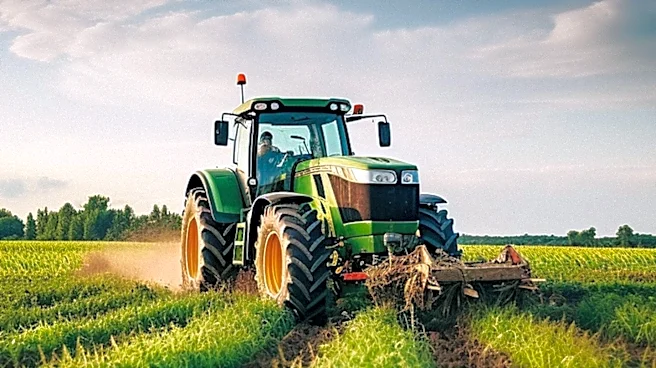
Dave Paulk of BKT, a tire manufacturer, highlights the critical role of wheel offsets in agricultural machinery. According to Paulk, there are two primary types of wheel offsets: positive and negative. The specific offset required for an agricultural wheel is
entirely dependent on the machine's configuration and its intended application. This technical detail is crucial for ensuring proper functionality and performance of farm equipment. The discussion also touches upon other vital wheel measurements such as diameter, width, bolt circles, center bores, and knurling, emphasizing that a tire physically fitting on a wheel does not guarantee optimal performance. These measurements collectively determine how the wheel sits in relation to the mounting surface and the overall machine.
Why It's Important?
The precise understanding and application of wheel offsets are vital for the agricultural sector in the U.S. Incorrect offsets can lead to significant operational inefficiencies, premature wear and tear on machinery, and potentially unsafe conditions. For instance, proper positive offset ensures tires clear critical components like frame rails, steering parts, and suspension. This directly impacts the longevity of equipment and the safety of operators. Furthermore, in specialized applications like row-crop farming, achieving specific row spacing necessitates accurate offset calculations to ensure the tire sits in the correct position on the tractor. The economic implications are substantial, as optimized wheel configurations can reduce maintenance costs, improve fuel efficiency, and enhance crop yield through better equipment performance.
What's Next?
As agricultural technology continues to advance, the importance of precise wheel specifications, including offsets, will likely grow. Manufacturers and farmers will need to stay informed about the latest wheel designs and their compatibility with new machinery and tire technologies, such as IF (increased flexion) and VF (very high flexion) tires. The industry may see further standardization or more sophisticated tools for calculating and verifying optimal offsets for diverse agricultural applications. Training and educational initiatives for farmers and technicians on the nuances of wheel mechanics, including offsets, will be crucial to maximize equipment performance and minimize operational risks in the evolving agricultural landscape.
Beyond the Headlines
Beyond the immediate operational benefits, the focus on precise wheel offsets reflects a broader trend in agriculture towards optimizing every component for maximum efficiency and sustainability. This attention to detail in machinery design and application can contribute to reduced environmental impact through more efficient use of resources and less soil compaction. The technical intricacies of wheel design, often overlooked, underscore the sophisticated engineering behind modern farm equipment. This also highlights the interdependence of various components—tires, wheels, and machinery—where a failure in understanding one aspect can compromise the entire system, emphasizing the need for holistic approaches in agricultural engineering and practice.