
What's Happening?
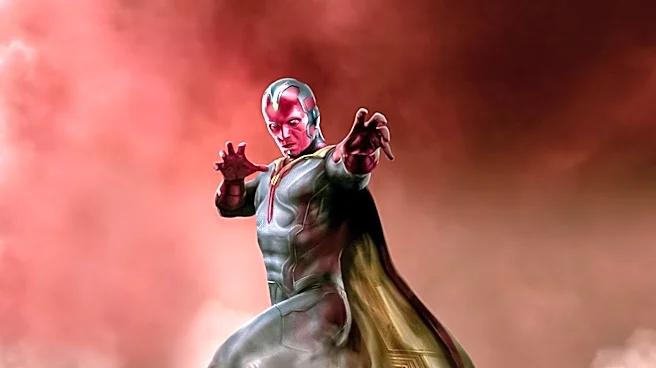
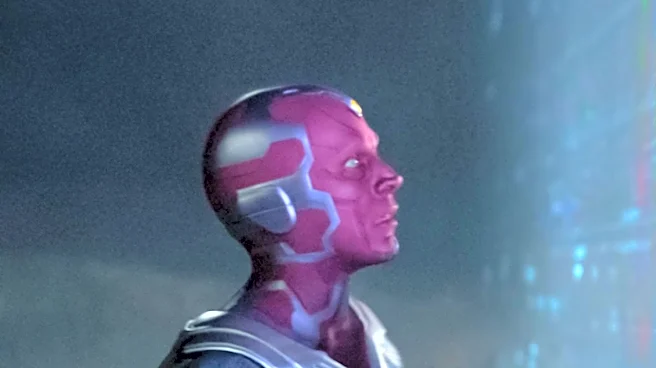
The Marvel Cinematic Universe (MCU) series 'VisionQuest' has concluded its run on Disney+, offering a new interpretation of the Vision's origins. Unlike the comic books where Simon Williams, also known as Wonder Man, served as the human template for Vision’s
mental patterns, the MCU series presents an Astro Boy-style origin. In this adaptation, Vision's human template is based on the deceased son of a scientist named Phineas Horton, drawing a resemblance to Ultron. The series also introduces new characters to the MCU, such as Jocasta, who is portrayed as a scientist named Josephine Carrington rather than an android wife for Ultron. Additionally, Paladin makes an appearance, frequently engaging in action sequences. The series explores multiple AI personalities within androids, sometimes making it challenging to distinguish characters, a creative choice that emerged spontaneously from the actors according to the 'VisionQuest Official Podcast'.
Why It's Important?
The conclusion of 'VisionQuest' is significant for the MCU as it wraps up several long-running plot threads ahead of the anticipated 'Avengers Doomsday' film. By altering Vision's origin story from the comics, Marvel continues its trend of adapting source material to fit the cinematic narrative, potentially setting new precedents for how future character backstories are handled. The introduction of characters like Jocasta and Paladin, with their reimagined roles, expands the MCU's roster and could lead to new storylines and character interactions in subsequent projects. The series' focus on AI personalities and the complexities of their interactions may also reflect broader societal discussions around artificial intelligence, albeit within a fictional context. This creative approach impacts fan expectations and the overall direction of the MCU's narrative continuity.
What's Next?
With 'VisionQuest' concluding, the immediate focus for MCU fans shifts towards 'Avengers Doomsday,' which the series is positioned as a precursor to. The reimagined origins and character introductions in 'VisionQuest' could have ripple effects on future MCU films and series, particularly concerning the Vision and Ultron family-related characters. The absence of key comic book figures like Ant-Man, Tony Stark, Scarlet Witch, Grim Reaper, and Wonder Man in this series suggests that their roles in the broader MCU narrative might be explored in different contexts or future projects. The return of Wanda's sons, Billy and Tommy, to life in 'VisionQuest' also sets up potential future storylines for these characters within the MCU.
Beyond the Headlines
The creative decisions in 'VisionQuest,' particularly the departure from comic book origins for characters like Vision and Jocasta, highlight the ongoing tension between source material fidelity and cinematic adaptation in large franchises. While the series aims to entertain and wrap up plot threads, these changes can spark debate among long-time comic fans regarding the integrity of character backstories. The portrayal of multiple AI personalities and their squabbles could be seen as a commentary on the complexities and potential chaos of advanced artificial intelligence, reflecting contemporary anxieties about AI development. Furthermore, the spontaneous creative input from actors, as mentioned in the official podcast, underscores the collaborative and evolving nature of storytelling in major productions, where the final product can be shaped by on-set dynamics as much as by initial scripts.