





What's Happening?
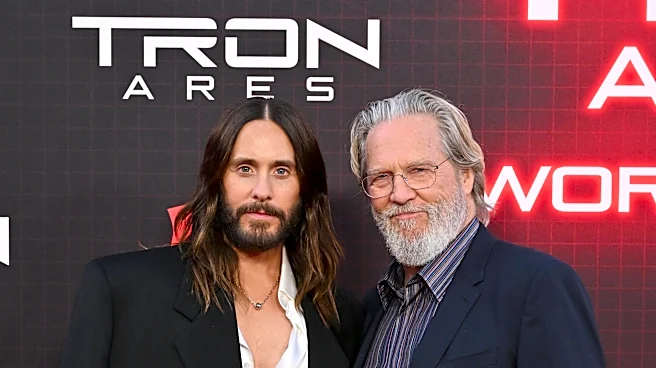
Jared Leto is widely recognized for his method acting, a technique that involves extreme physical and psychological transformations for his roles, often staying in character off-set. This immersive approach has drawn comparisons to legendary actors like
Daniel Day-Lewis, who is also known for his profound commitment to character. Leto's transformations include significant weight loss for 'Requiem for a Dream' and 'Dallas Buyers Club,' and substantial weight gain for 'Chapter 27.' His commitment to character was notably discussed during the filming of 'Suicide Squad,' where he played the Joker. Leto's career spans both acting, for which he won an Oscar for 'Dallas Buyers Club,' and music, as the frontman of the band Thirty Seconds to Mars.
Why It's Important?
The comparison of Jared Leto's method acting to that of Daniel Day-Lewis highlights a significant aspect of contemporary acting techniques and their impact on performance. Both actors exemplify a deep, often physically demanding, dedication to their craft, which can result in highly compelling and memorable portrayals. This approach often generates considerable discussion within the industry and among audiences about the boundaries of artistic commitment. While some view it as essential for authentic character development, others debate its necessity and potential impact on an actor's well-being and on-set dynamics. Leto's continued use of method acting, following in the footsteps of revered figures like Day-Lewis, reinforces its enduring presence and influence in Hollywood, shaping expectations for intense, transformative performances.
Beyond the Headlines
The discussion around Jared Leto's method acting, particularly in comparison to Daniel Day-Lewis, delves into the broader philosophical and practical aspects of performance art. It raises questions about the psychological toll such immersive techniques can take on actors and the ethical considerations of maintaining character off-set. While method acting can lead to critically acclaimed performances, it also sparks debate about whether such extreme measures are truly necessary for artistic excellence or if they sometimes serve as a form of publicity. The legacy of actors like Day-Lewis has set a high bar for commitment, influencing a generation of performers like Leto to push their own boundaries. This ongoing conversation reflects the evolving nature of acting as a discipline, balancing artistic integrity with personal well-being and professional conduct.