





What's Happening?
San Francisco-based Multiply Labs has successfully raised $75 million in a Series B funding round. The company plans to utilize these funds to significantly expand its manufacturing capacity, accelerate its product development roadmap, and grow its engineering,
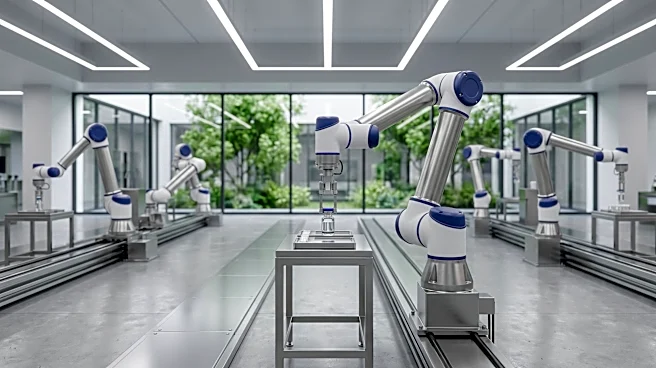
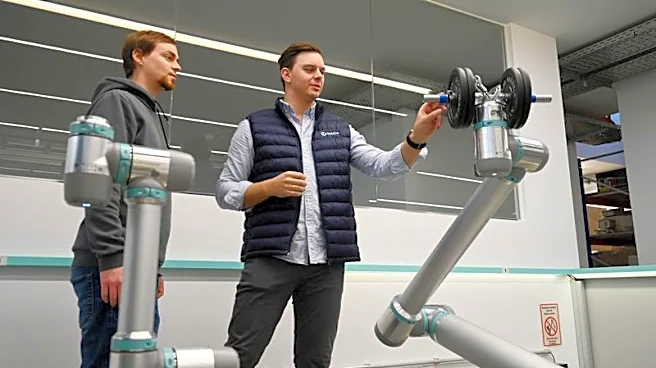
regulatory, and commercial teams. This expansion is aimed at transitioning the company's operations from clinical-stage deployments to commercial-scale production of biologics. Multiply Labs specializes in a robotic-cluster platform designed to automate repetitive steps in biologics manufacturing within GMP-compliant systems. This technology is engineered to integrate seamlessly with existing instruments and processes, eliminating the need for new facilities or changes to validated workflows. The company reports that its system can achieve a 74% reduction in cost per dose and up to 100 times higher throughput compared to manual manufacturing.
Why It's Important?
This significant investment in Multiply Labs underscores the growing importance of automation and robotics in the pharmaceutical and biotechnology sectors, particularly in the U.S. The ability to scale biologics manufacturing efficiently and cost-effectively has profound implications for drug development and accessibility. By reducing the cost per dose and increasing throughput, Multiply Labs' technology could accelerate the production of critical therapies, including cell and gene therapies, antibodies, viral vectors, and mRNA. This advancement could lead to faster market entry for new drugs, lower healthcare costs, and improved patient access to life-saving treatments. The company's model, where pharmaceutical companies own and operate the robotic clusters, also enhances control over production, data, and supply chains, which is crucial for regulatory compliance and intellectual property protection in the highly regulated biologics industry.
What's Next?
Multiply Labs will focus on expanding its manufacturing infrastructure and accelerating its product roadmap. The company has existing agreements, such as one with AstraZeneca to evaluate GMP-ready robotic systems for commercial-scale cell-therapy manufacturing, and a collaboration with GenScript Biotech to automate cell-isolation and enrichment. These partnerships are expected to progress, potentially leading to broader adoption of Multiply Labs' technology within the pharmaceutical industry. The increased funding will also enable the company to scale its teams, suggesting a period of rapid growth and innovation. Future developments will likely include further integration of their robotic platforms into various biologics manufacturing processes and potentially new partnerships to expand their market reach.
Beyond the Headlines
The success of Multiply Labs reflects a broader trend towards 'Industry 4.0' principles within the biopharmaceutical sector, where automation, AI, and robotics are transforming traditional manufacturing processes. This shift is not merely about efficiency but also about enhancing precision, reproducibility, and compliance in complex biological production. The emphasis on GMP-compliant systems and the ability to integrate with existing workflows addresses key challenges faced by pharmaceutical companies in adopting new technologies. Furthermore, the focus on reducing cost per dose and increasing throughput could democratize access to advanced therapies, making them more affordable and available to a wider patient population. This technological evolution could also foster greater innovation in drug discovery and development by providing more robust and scalable manufacturing solutions.